comment 0

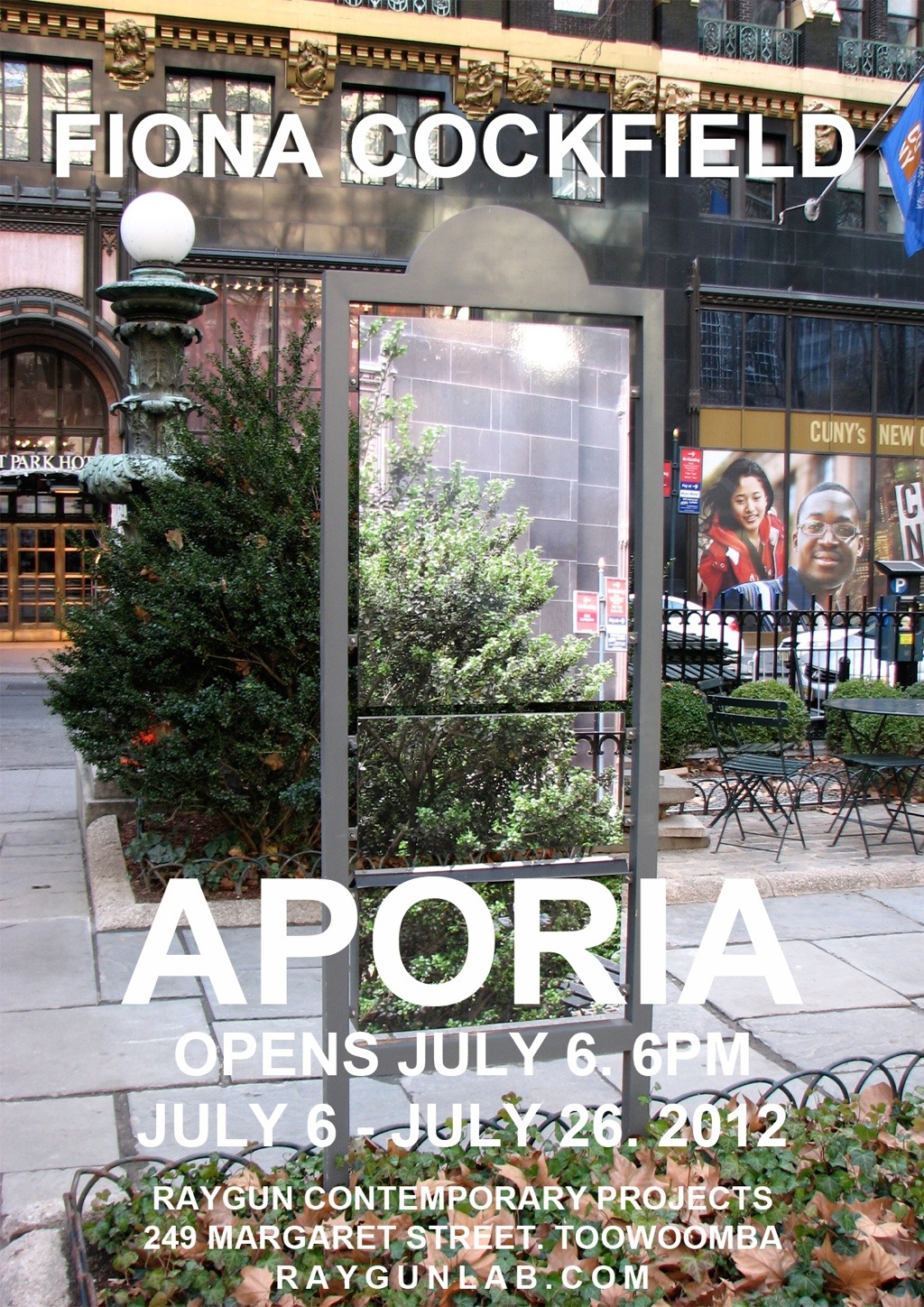
FIONA COCKFIELD – APORIA

This slideshow requires JavaScript.

Fiona Cockfield’s ‘Aporia’ opened last night, it is a great show and should not be missed. Fiona spoke beautifully about her work discussing issues to do with space, the void, perception and the banal.

“I can never fully grasp it, hold it, own it – just like a moment in reality, a memory, it never really belongs to me even though it seems I am so close to it. I am too close and thus I am removed.” Fiona Cockfield

The artist statement reads:

Aporia engages ideas of representation and the failures that come about through the literal and conceptual representations seen in art and imagery. This exhibition embraces the idea of failure by utilising painting and photography to direct attention to each medium’s own flaws as representational devices.

For more information and a great interview with the artist see the previous posts about Aporia.


To view the work call 0418603695 and organise a time.


comment 0

Susan Hiller

At the moment I’m reading The Provisional Texture Of Reality – Selected talks and texts by Susan Hiller between 1977 and 2007. Her output in both practice and writing are extensive. Her web site is below if you feel like delving further but I just thought I’d share one of her works which is a favourite.

http://www.susanhiller.org/Info/artworks/artworks-lastsilentmovie.html

20120704-223851.jpg

comment 0

Visit to MONA in Hobart

This slideshow requires JavaScript.

A couple of weeks ago I flew down to Hobart to visit a girlfriend and check out MONA, The Museum of New Art which I’ve been reading about for over a year now. The genius guy who is responsible for the creation of this world class museum is David Walsh. Apparently born with an ability to memorise numbers and hands in a deck of cards, he made all of his money at casinos around the world. He decided to dig into the sandstone cliff just north of the city of Hobart, Tasmania, and hauled in the architects to build what is now a 3 storey expanse filled with new and ancient art – nothing in between. I’m not sure which was most impressive, the diverse and ‘in your face’ art work which is creating worldwide mixed and strong reviews, or the architecture which is a combination of steel, sandstone and glass. Nothing has been left overseen with attention to detail everywhere. Upon entering you are handed an iPod with an interactive screen to read about each art work (the iPod can detect where you are in the Museum). You can update the iPod with your opinion of weather each particular work is a like or not then have this information emailed to you. The shows are periodically renewed and unfortunately I wasn’t there to see the ‘Wall of Vaginas’. I highly recommend the visit, both Hobart and MONA are on my regular to do list. T

comment 0

SYDNEY BIENNALE

This slideshow requires JavaScript.

Here are some shots from different installations around Cockatoo Island for the 2012 Sydney Biennale. Also attached below is some info on the theme of the Biennale from the website.

For more check out www.bos18.com


18th Biennale of Sydney: all our relations

Artistic Directors: Catherine de Zegher and Gerald McMaster

We are moving on from a century in which the radical in the arts largely adopted principles of separation, negativity and disruption as strategies of change. Based on oppositional thinking, such modernist principles proved tenacious and acted as a default criticality in a world in which the drive to progress became more complicated and the consequences more ambiguous.

A changing reality is apparent in a renewed attention to how things connect – how we relate to each other and to the world we inhabit. Art is a part of this growing awareness. Where once there was an emphasis on alienation and distance, there are now concurrent shifts of thinking that are informing the work of artists and writers across the world. These shifts – incipient and partly unformed – are only now beginning to be acknowledged, but are of real significance.

In the arts, as elsewhere, analytical reflection has led to an understanding that human beings are highly dependent upon our often overlooked relationships with others and with our common world. While this connective model is still embedded in a few societies, established western cultural patterns have tended to emphasise the fragmentation and isolation of the individual. As a result, there are relatively few remaining models of participatory forms of perception and sensibility. A reciprocal relation calls for a profound re-evaluation and the development of new models of working together within our changing reality. One of the things that art can do is to allow us a space for such attention – for thinking together that is open-ended.

The 18th Biennale of Sydney focuses on inclusionary practices of generative thinking, such as collaboration, conversation and compassion, in the face of coercion and destruction. With the creation of conditions for an encounter in consonance with our surrounding world, this event brings emphasis to what is already happening at large. Drawing on the possibility of the present, the Biennale emerges from the engagement of all participants by using a model that begins with two curators in dialogue. This matrix of conversation extends to both artists and audiences in a multi-vocal correspondence.

all our relations relies on these various exchanges, affinities and empathies as its dynamic structure, the vascular and cellular structure and sinew of a kind of living, breathing organism, from which the Biennale’s meanings grow. Artists work in a context that allows for mutual recognition and audiences from differing backgrounds are part of this continual development, finding their own direction in these connections. It is in this altered attention to one another, in the meeting and making of ideas together, that constructive consequence can follow.

In seeking conjunctive energies, this collaboration has taken place on many different levels: in co-existence, conversation and juxtaposition but also in purposeful connectivity. Within this framework of mutuality, recognition and thoughtfulness, disparate ideas – some distantly and some closely related – are brought together in an exhibition process of composition; much akin to the process of thought itself. Artists, who can often feel isolated in their practice, come together with neighbouring artists. Rather than one work appearing to link to one or two other works, an attunement between all creative impulses takes place in time. Projects correspond as if evolving from each other and progress through the sequence of venues and buildings. This interconnection and interdependency occurs in the knowledge that audiences will take elements from the exhibition and connect them with their own experiences. In this shared space, the meaning and consequence of the artists’ works is engendered.

all our relations has its roots in storytelling as it is currently being re-imagined, as a coming-into-being in relation. In the reciprocity that is storytelling, both teller and listener inhabit the space of the story. Telling stories connects us and allows us to care, to be: it fosters collaboration; it aggregates knowledge and generates new ideas; it ignites change; and, ultimately, it builds community. In this matrix, the different projects can be compared to a set of storylines, which artists, curators and audiences relate and translate. Through this process, a collective composition or new Gesamtkunstwerk is accomplished in the active generation of meanings realised by all those who take part, each taking their stories home and beyond …

comment 0

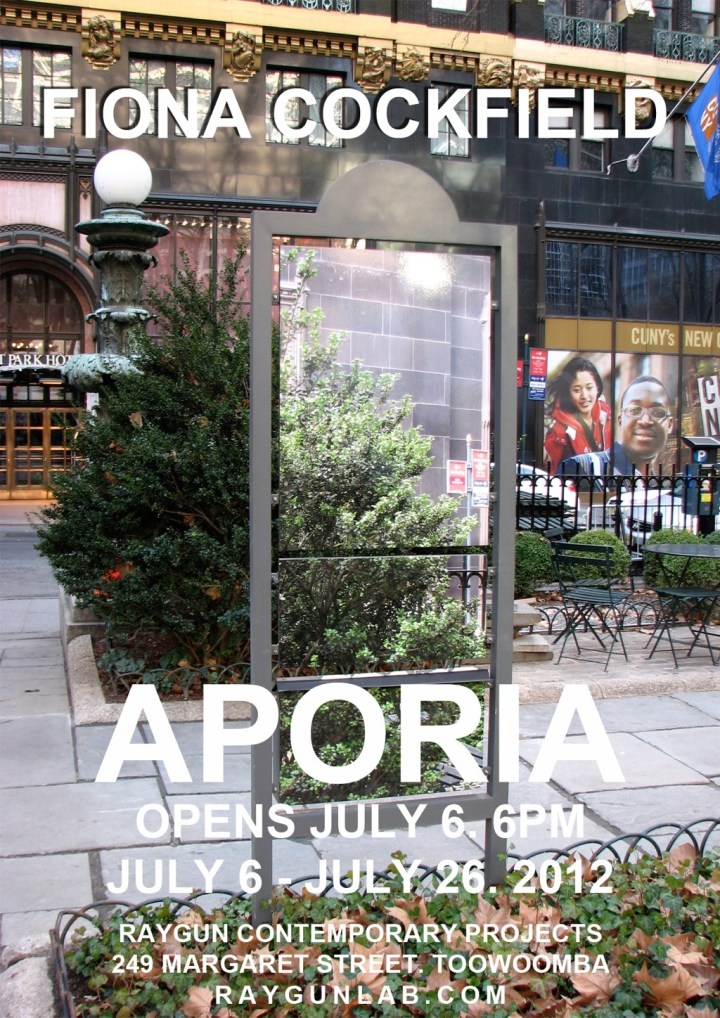
Fiona Cockfield APORIA

“I can never fully grasp it, hold it, own it – just like a moment in reality, a memory, it never really belongs to me even though it seems I am so close to it. I am too close and thus I am removed.” Fiona Cockfield

Aporia engages ideas of representation and the failures that come about through the literal and conceptual representations seen in art and imagery. This exhibition embraces the idea of failure by utilising painting and photography to direct attention to each medium’s own flaws as representational devices.

By nature any art form is always to be a re-presentation of something because art always involves the artists’ and viewers’ perceptions based on their experience. Because painting has a history associated with an inability to replicate reality, painting has become a means of engaging with the limits of the representable. Untitled (30/08/11) has it’s own enquiry into the space outside of what is presented, not only through the mechanical reproduction of the photoshop and painting processes but also through the conceptual origins of mnemonic experience and the failures that occur through such a process.

Photography is also a medium that becomes intwined with ideas of reality, representation and memory. A photograph deceives the viewer through it’s materiality as is attributed to showing ‘reality’. This facade of photography allowed for photography’s failures as a representational tool to easily be shown through I don’t really know what I am looking at. What is the purpose of a portrait? To show ones character, their thoughts, their beliefs, their experiences? A portrait shows everything of the face and simultaneously shows nothing. Without inhibition, I don’t really know what I am looking at and Untitled (30/08/11) investigate their own geneses as aspects that cannot be shown within the work.

Aporia is about representation and it’s failures but it is also more. Aporia concentrates on what cannot be shown through the images. Familiarity breeds blindness. So what better way to point to the gaps underneath the visual than that of the familiar? To contradict Kyle Jenkins, a respected lecturer at USQ, “it is what it is not”.

As a practicing artist what are the issues\concerns you have been consistently addressing within your artwork?

Well I’ve always found my work to possess these tensions in which it will try to be something or say something whilst also expressing the opposite, as if it has this conversation with itself that can never be resolved. I first saw this when I started to work with pornographic imagery. This kind of imagery was not used as a statement but more like an investigation into the collapse of reality and fantasy. I liked the idea of the appearance of reality, a façade.

During my Honours year I began to look at the idea of paradox, desire and banal imagery. I came to the conclusion that banal imagery has this opposite effect on the viewer. The picture seems to withhold information and creates a sensation where the viewer is fixated on the unknown. This is where my current line of inquiry is situated at the moment.

2. Do you classify your art as being one thing more than the other e.g. photography, film, painting, sculpture, music or installation and do you see an expansion into other mediums in the future?

No. Every medium is a material for me. It provides me with the freedom to associate a particular idea with the medium that suits it. At the moment it’s mostly painting and photography because those mediums are relevant to the ideas of interest at the moment. Yes I always see an expansion into a variety of mediums.

3. When you think about making new work do you always consider applying a degree of historical content or do the works weigh more heavily towards a more personal investigation?

My work always encompasses a historical element because I like art theory and I don’t like my work to be closely aligned with personal experience. There is no avoiding my work possessing personal elements. I think that is necessary. I just like to keep that distance, which in itself says a lot about my character.

4. When you look back through this body of work do you see any answers unfolding within this investigation?

Answers? I never see answers. All I see is more questions. My art practice has never been focused on finding answers otherwise I think I should have done mathematics or science. I think that is why I like art; it will always be a continual search without total resolution. Sometimes I will feel satisfied but that feeling will just give way to another line of inquiry. I do see a kind of evolution through my art practice, whether it’s good or bad doesn’t necessarily matter, it just changes.
20120704-224533.jpg

comment 0

Multimedia | BMW Guggenheim Lab

Multimedia | BMW Guggenheim Lab.

The Guggenheim lab is exploring the re-invention of cities, one of their aims is seeing things in a different light, creating an open access for citizens to access architects, artists, innovators and unconventional thinkers. The Guggenheim lab demonstrates how museums are changing to engage with cities and the people.