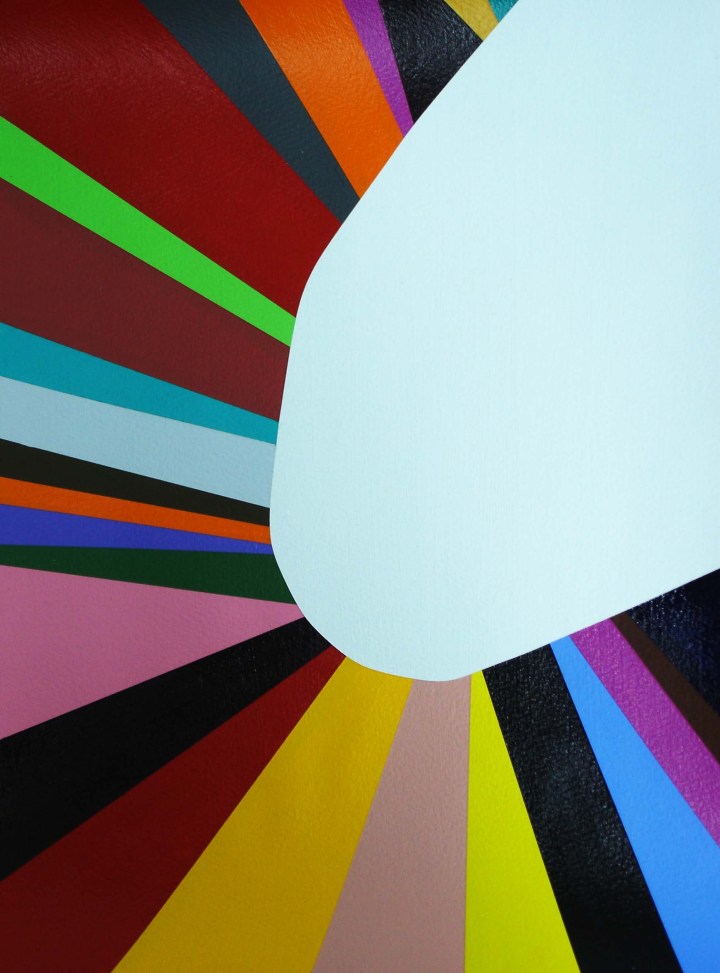
On the eve of Kyle Jenkins solo at RAYGUN –
I tried to put myself in the shoes of people who would be passing by the space (RAYGUN), look in through the window and wonder what the paintings in Kyle’s upcoming show are all about. Here a few questions I asked him and his response to them.
RAYGUN Contemporary Art Space –
Interview with Kyle Jenkins by Tarn McLean 2nd October 2011
1. As a practicing artist what are the issues\concerns you have been consistently addressing within your artwork?
I think being an artist is a really serious occupation. In Europe it is equal to being a doctor or a lawyer as all three are about humanity, the body and about our physicality and existence within time, place and space. A doctor obviously keeps the body healthy, a lawyer protects the rights of the body in some form or another, and as for art well no other animal / entity creates to the extent that we create. Artworks give us faith in things we can sometimes see and experience but in other moments make us rethink things we take for granted. Artwork also presents us with possibilities, where to see the work you need to look at it, then through it and finally beyond it to find not only the reason for it existing but for the possibilities that are inherent within it.
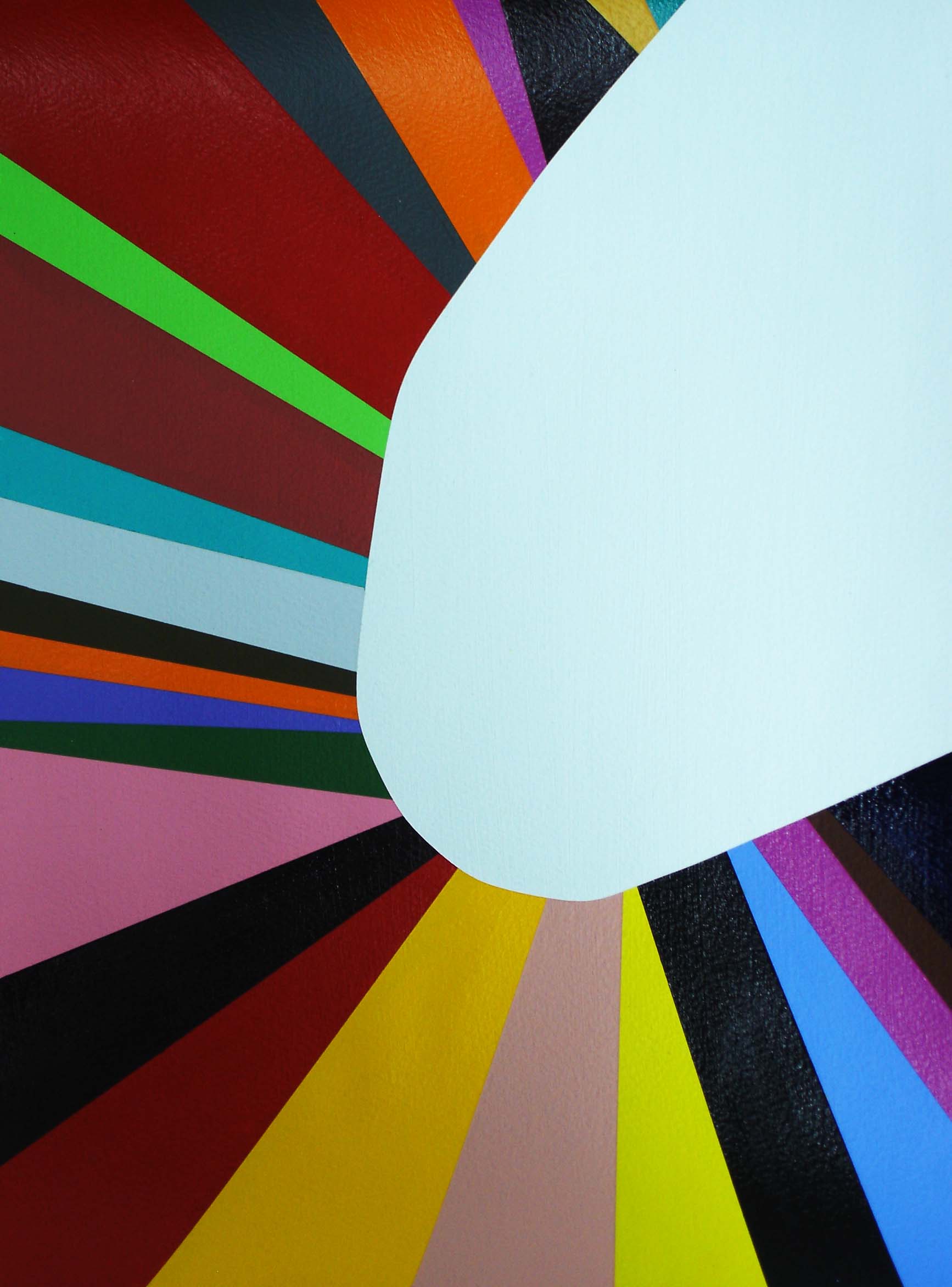
My practice for the past 13 years has been concerned with aspects of intuitive abstraction which incorporates hard edge and organic abstraction as well shifting methodologies of mark making and spatial narratives that are situated within painting, collage, photography, maquettes, books, film, wall paintings and works on paper. These works involve the deconstruction and reconstruction of various relationships between conceptualised and physical interpretations of space. As humans we confine, expand and grid various interpretations of space into evolving forms of activity and it is through this continuing synthesis that the work has continued to be developed.
Currently my aim is to expand upon the aesthetic possibilities of structures and how these are a way of examining the world as a series of abstract compositions and constructions. Through this the composition of the work is a procedure of sampling and layering space, ideas and theories using the various ideas of layering and collage not only as technique but also as a strategy. The work as a whole is a series of relational forms or fields of opportunities rather than separate and limited objects, and thus creates a system of references, hybrids, negotiations and reinterpretations from work to work, image to image.
Through the very basic elements of line, colour, form and surface the work investigates how the double exposure between what the image looks like and how it is constructed and the displacement of space can lead to new spatial experiences. Thus the work creates a kind of ‘play’ between form and void – for example the form of the gap in one art piece constitutes the actual shape of the next one. This method of working further investigates the connections between formal and informal methodologies of abstraction and thus the work constantly examines the mapping and reconstruction of imagined urban terrains, geometry, colour, representation and fractural compositions.
2. Do you classify your art as being one thing more than the other e.g. painting, sculpture, music or installation and do you see an expansion into other mediums in the future?
Primarily I am a painter. What type of painter who knows. Some would say abstraction but the word abstract means to change something realistic and to present it in a new format, showing different characteristics of the original e.g. Cubism. I think my work is not abstract (but I use this term as an historical reference) but is about reality, my reality. The reality of how I see the world, experience colour, think about imagined, constructed and felt space and how borders and boundaries are present within all facets of our lives. However in saying that, history would suggest to me that I am delusional because the work is abstract, and that it is. But I would disagree because nothing is ever made of one thing. Everything is made of various parts that when separate they could be considered abstract but when they are placed together create a form of realness or reality e.g. think of a jigsaw puzzle where the abstract parts come together to create an image or a constructed reality. I think that is what my work is about. But in saying that I have done a variety of different works especially in the last 4 – 5 years. Photography, wall paintings, installations, text work, film, artist books, sculptures, works on paper. All these areas of work have been created with the same intentions in mind, they just give you through their materiality a different sensibility or perspective for looking not just at the work, but my entire artistic output in general. However if someone said to me what do you classify your work as using only one word, I would say PAINTING.
3. When you think about making new work do you always consider applying a degree of historical content or do the works weigh more heavily towards a more personal investigation?
I would say more of a personal investigation. I think most if not all work has this present within it. Obviously the work touches on various histories that have occurred within art and culture. However for myself I am always looking to find the gap that has occurred between things and to then expand upon that in a personal way. For example Modernism in art was about art movements and about creating art that pedagogically was created based on the rules or guidelines of the group each individual artist was engaged with. Then Post Modernism came along and used Modernism as a way of essentially terrorizing all that had been produced previously. Post Modernism wanted to take the space away from in between art movements and to appropriate parts as a way of critiquing, copying, using and abandoning various elements within the Modernist idiom. For myself I find this kind of approach negative and insensitive. The late 1960s and 70s is a period that I am still most interested in (however I have a constantly evolving set of interests), where the need to either critique art history was abandoned for a more heightened discourse involving art, design, architecture, society, culture and politics. It is here that I think the gap still exists where a personalized philosophy can exist, create and question the various inhabited and constructed spaces we have created as humanity in a positive not negative way. To truly see you really need to forget how you’ve been taught to see and to instead starting looking beyond the obvious.
4. Your series of Urban Geometry are numbered up to almost four hundred now. When you look back through this body of work do you see any answers unfolding within this investigation?
I think every artwork I make is a failure. A failure because no one artwork can ever say everything I want to say, that’s why I make another one. In saying that though when you make artworks they have an immediacy at the time they are created that makes it hard to see them for what they truly are. Looking back over time and seeing the work I have done makes me think about the possibilities within the work and this can lead to new experiments or artwork in the studio. In saying that I am always working on several different series of works at the same time, as different galleries want different work, but also I work in this way so that when I finish working on one work and then look at a different type of work it allows me to view it with fresh eyes so that I can see what is or isn’t working in the piece. It also allows me to be more objective rather than subjective when creating whatever it is I am making at that particular moment.
5. On being an educator and teacher within the field of your practice, do you see this as an opportunity to further understand your own investigation?
I am not sure if being an educator or teacher means anything to my practice. I think time is a valuable material in an artists work, as it is one of the most important materials that I feel we forget about or neglect. I think time comes in many configurations: The time to look at a work and really see what it is you’re looking at. I think the time after you have made an artwork or an exhibition which allows you to reflect on the possibilities that may be there in the work, the time to not make any work and to read and wander around and experience the world as well as time sitting in your studio just looking at all the information you have collected or unfinished work that sits around inside that space, the time it takes from the moment you are first asked to exhibit your work to the time it takes to think about what to make and then the time it takes to make the work and then to install it in the gallery. I think all this form of time as well as other issues are important factors within any artwork or art practice. These are the opportunities that mean the most to me. As for teaching I think that has to do with setting or building a platform to assist people in achieving whatever they wish to achieve within their own artwork.
 RAYGUN