comment 1

EIDIA HOUSE OPENING NIGHT

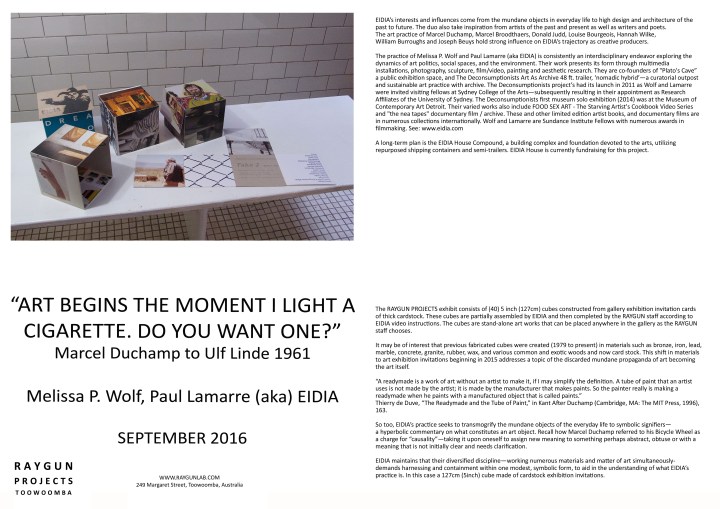
On Friday night we had the opening of Paul and Melissa’s project EIDIA House. A segment of an extended project that has been in place since 1979, the works consisted of 40 cubes, made up from exhibition invitations from different galleries visited by Paul and Melissa in New York. Engaging with the each individual artwork gave reference to not only a Judd box moment, but also is like visiting a collection of exhibitions in down town New York from around 2011 to now. A conceptual and aesthetically beautiful representation of the ready-made.


This slideshow requires JavaScript.

EIDIA’s interests and influences come from the mundane objects in everyday life to high design and architecture of the past to future. The duo also take inspiration from artists of the past and present as well as writers and poets. The art practice of Marcel Duchamp, Marcel Broodthaers, Donald Judd, Louise Bourgeois, Hannah Wilke, William Burroughs and Joseph Beuys hold strong influence on EIDIA’s trajectory as creative producers.

The practice of Melissa P. Wolf and Paul Lamarre (aka EIDIA) is consistently an interdisciplinary endeavor exploring the dynamics of art politics, social spaces, and the environment. Their work presents its form through multimedia installations, photography, sculpture, film/video, painting and aesthetic research. They are co-founders of “Plato’s Cave” a public exhibition space, and The Deconsumptionists Art As Archive 48 ft. trailer, ‘nomadic hybrid’—a curatorial outpost and sustainable art practice with archive. The Deconsumptionists project’s had its launch in 2011 as Wolf and Lamarre were invited visiting fellows at Sydney College of the Arts—subsequently resulting in their appointment as Research Affiliates of the University of Sydney. The Deconsumptionists first museum solo exhibition (2014) was at the Museum of Contemporary Art Detroit. Their varied works also include FOOD SEX ART – The Starving Artist’s Cookbook Video Series and “the nea tapes” documentary film / archive. These and other limited edition artist books, and documentary films are in numerous collections internationally. Wolf and Lamarre are Sundance Institute Fellows with numerous awards in filmmaking. See: http://www.eidia.com

A long-term plan is the EIDIA House Compound, a building complex and foundation devoted to the arts, utilizing repurposed shipping containers and semi-trailers. EIDIA House is currently fundraising for this project.

The RAYGUN PROJECTS exhibit consists of (40) 5 inch (127cm) cubes constructed from gallery exhibition invitation cards of thick cardstock. These cubes are partially assembled by EIDIA and then completed by the RAYGUN staff according to EIDIA video instructions. The cubes are stand-alone art works that can be placed anywhere in the gallery as the RAYGUN staff chooses.

It may be of interest that previous fabricated cubes were created (1979 to present) in materials such as bronze, iron, lead, marble, concrete, granite, rubber, wax, and various common and exotic woods and now card stock. This shift in materials to art exhibition invitations beginning in 2015 addresses a topic of the discarded mundane propaganda of art becoming the art itself.

“A readymade is a work of art without an artist to make it, if I may simplify the definition. A tube of paint that an artist uses is not made by the artist; it is made by the manufacturer that makes paints. So the painter really is making a readymade when he paints with a manufactured object that is called paints.”
Thierry de Duve, “The Readymade and the Tube of Paint,” in Kant After Duchamp (Cambridge, MA: The MIT Press, 1996), 163.

So too, EIDIA’s practice seeks to transmogrify the mundane objects of the everyday life to symbolic signifiers—a hyperbolic commentary on what constitutes an art object. Recall how Marcel Duchamp referred to his Bicycle Wheel as a charge for “causality”—taking it upon oneself to assign new meaning to something perhaps abstract, obtuse or with a meaning that is not initially clear and needs clarification.

EIDIA maintains that their diversified discipline—working numerous material and matter of art simultaneously—demands harnessing and containment within one modest, symbolic form, to aid in the understanding of what EIDIA’s practice is. In this case a 127cm, (5×5 inches) cube made of cardstock exhibition invitations.

EIDIA STUDIO NY

This slideshow requires JavaScript.


comment 0

This Saturday GHOSTS OF NOTHING

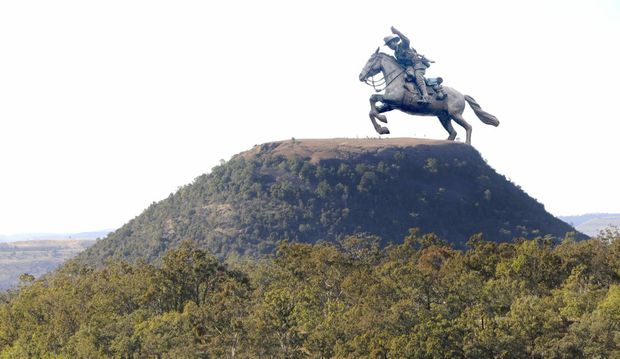
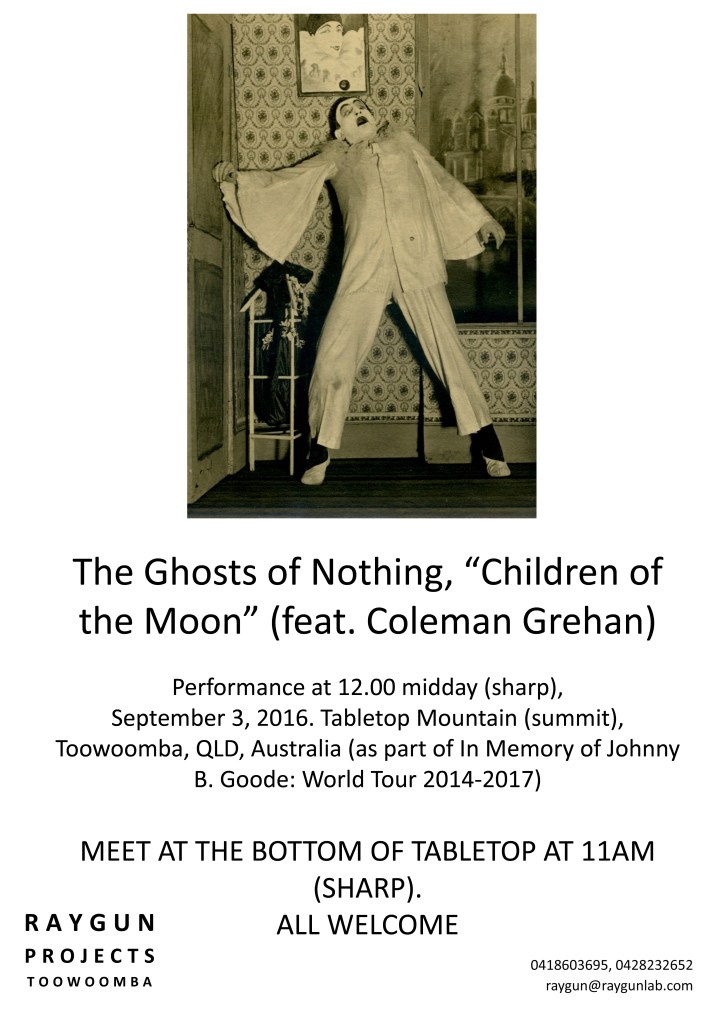
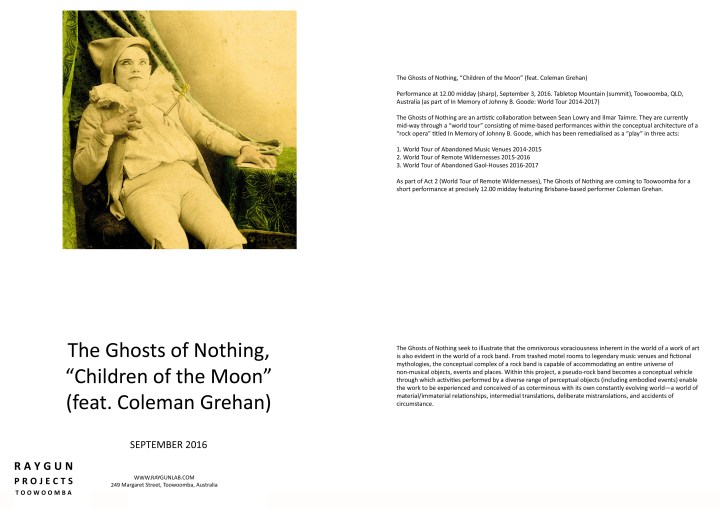
This Saturday we are stoked to be hosting a performance The Ghosts of Nothing, “Children of the Moon” (feat. Coleman Grehan), starring Sean Lowry and Ilmar Taimre. A musical performance by The Ghosts of Nothing, “Children of the Moon”, a crew from Newcastle and Brisbane will take place at the summit at 12 midday.

Tabletop

* Photo Nev Madsen / The Chronicle

The artistic collaboration is currently mid-way through a series of imagined and mim-based performances within the conceptual architecture of a “world tour” of a “rock opera” titled In Memory of Johnny B. Goode that has been remedialised as a “play” presented in three acts:

1. World Tour of Abandoned Music Venues 2014-2015

2. World Tour of Remote wildernesses 2015-2016

3. World Tour of Abandoned Gaol-Houses 2016-2017

The Gosts of Nothing conspicuously exploit the fact that aesthetic experience is produced both within and beyond direct sense of perception. The partly imaginary, partly realised, and partly digitally documented In Memory of Johnny B. Goode – World Tour began with nothing but a listen go f18 ‘dates’ at historically famous abandoned or discontinued live music venues in various international locations advertised on a full page in the Italian art magazine Mousse #45 (October-November 2014).
Jump on board and become a part of this historical event.
Lets venture
GON Poster2 GON Catalogue2


comment 0

Distant Friends – Jen Delos Reyes

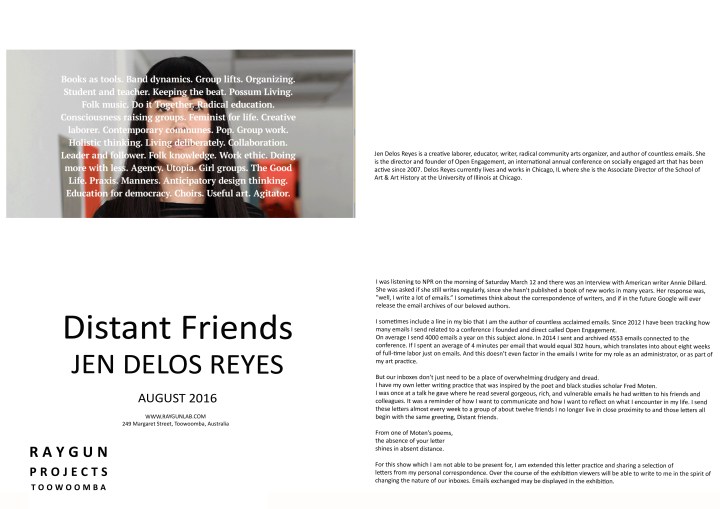
On Friday night we opened an exhibition by Chicago based artist Jen Delos Reyes, the exhibition featured a series of emails that Jen sent to a group of friends upon her move to Chicago in 2015. The emails are well written discussions touching on life, love, and art, as a reflection of Jens experiences. Visitors are invited to respond to the emails by sending an email to Jen, which could be included in the exhibition.  The show had a warm reception and many felt they would love to spend more time reading and reflecting. I have also included below a brief discussion that occurred on the opening night.

This slideshow requires JavaScript.


comment 0

Painting. More Painting

Whlie we’re on the subject, here’s an interesting read on Painting today, and if you’re in Melbourne town check out the two part exhibition Painting. More Painting at The Centre of Contemporary Art curated by Max Delany, Annika Kristensen and Hannah Mathews.

Not just a visual experience for the viewer, but an essential, ontological expression of time, space and place for the maker.

image

Helen Johnson Barron Field 2016. Installation view. Courtesy the artist and Mary Mary, Glasgow

comment 0

PAINTINGONTOPOFITSELF: THE AGREEABLE SURFACE CURATORS TALK

This exhibition/publication ‘The Agreeable Surface’ curated by Dr Tarn McLean and Dr David Akenson surrounds a discussion of artists Gilbert Hsiao, Emily Kngwarreye and John Aslanidis.  Despite the curators PhDs both based in heavily philosophical issues surrounding painting, they are, through this publication/exhibition now making a new call. They are proposing that the surface of a painting should be able to be considered without any knowledge of the heavy theoretical painting history that has come before it (although they flag if as of course important), proposing that the viewer finding themselves liking the surface of the painting is enough.

Below is a fragment of the talk/discussion that occurred at the opening. It gives a hint of the rigorous wild discussions that Tarn and David engage in.  As Tarn explains in the video and in an earlier post, these exhibitions are a result of these discussion. This exhibition is a part of a series of five exhibitions and publications called ‘Paintingontopofitself’. ‘The Agreeable Surface’  is the second exhibition/publication after ‘Painting as Palimpsest’ in 2015. If you would like a copy of this earlier publication please write to us at raygun@raygunlab.com.


comment 0

PAINTINGONTOPOFITSELF: THE AGREEABLE SURFACE OPENING NIGHT

On Friday night we had the opening and discussion surrounding ideas of painting including beauty, aesthetics, history, politics, death and other. This addition to the five part project Paintingontopofitself offers a micro look at the history and development of Modernist painting by artists David Akenson and Tarn McLean. Thoughts concerning the intuitive nature of painting and the act of making were discussed through the works of Australian Indigenous artist Emily Kngwarreye, American artist Gilbert Hsiao and Australian John Aslanidis.

This slideshow requires JavaScript.

The Agreeable Surface: Gilbert Hsiao and John Aslanidis

The term “agreeable” was used by Immanuel Kant to refer to the pleasure derived from the experience of certain objects presented to the senses. Something is agreeable if it is pleasing to sight. As he put it, the agreeable is what the ‘senses find pleasing in sensation’, rather than, for example, pleasing to my understanding of what is morally good for society. The agreeable is personal. It is what I find pleasing to my eye. When I judge something agreeable to my senses, here in this space, occupied by my body, I make no broader claim for the object’s importance or value to society. This does not mean the object before my senses is of no value beyond its optical affects, but rather that I am not judging it against other criteria.

If we contrast this to what Kant calls the “beautiful”, or what I judge to be of value to the broader community, we notice that the beautiful lays claim to “universality” whereas the agreeable does not. As such, I expect others who share my taste to affirm that the object before us is beautiful. I demand the community’s assent.

The beautiful has dominated aesthetic discussions over the past century, leaving the agreeable as a marginal consideration for both artists and art critics.

The Agreeable Surface: Gilbert Hsiao, John Aslanidis and Emily Kngwarreye is an attempt to correct this oversight. The works in this exhibition are but three examples of many that might fall under the category of the agreeable. These artists’ present works that immediately address the eye – that strike the eye with a dazzling display of colour, line and plane. Enjoy!

David Akenson

NB. The work of Australian Indigenous artist Emily Kngwarreye, whilst not included in the title of the show, will be added to the publication and catalogue (following this show), as a way to further identify and give light to the aesthetic values that lay on top of the canvas surface.

Emily Kngwarreye (c.1910 – 1996) Australian indigenous artist drew on her Alhalkere Dreaming as a source of creative power and knowledge. Kngwarreye utilized the canvas surface as a way to systemize her connection with people as well as with the arch formation of the ancestor rock, Alhalkere. For Kngwarreye the Alhalkere was the place and law she continually re-created in her art.[1] In turn she utilized the picture surface as a way to visualize cultural connection to her community and county. Loaded with dots and stripes, her works repeatedly incorporate imagery that communicate the totality of her existence expressed as her Dreamings in all their manifestations.

Gilbert Hsiao (b.1956) is a US based artist. Hsiao’s practice explores the role of visual perception in art, through paintings that interrogate kinetic spatial design. It is influenced by the rhythmic patterning and sonar characteristics of hypnotic minimalist music from the seventies that are integrated in geometric op-art paintings. It also reflects on ancient Greek and Roman geometry, optics and perception, specifically addressing its influence on perspective and the field of astronomy during the Renaissance as well as its impact on contemporary optical and kinetic art.

John Aslanidis (b.1961) Australian artist uses a set of mathematical intervals to compose the paintings; these are relative to a symmetrical grid on each of the four canvases.

“This drawing that I use as a reference point to compose my paintings is akin to an algorithm or “musical score,” which allows me to improvise.”

‘I’ve explored this area further, collaborating with sound artists, mainly Berlin-based sound artist, Brian May, creating painting/sound installations. Vibration created by the kinetic resonance of the “Sonic Network” series occupies a sensory dimension, which exists between sound and vision. This interdisciplinary approach has a correlation with music, mathematics and science.’

The intention is to create imagery were there is no starting or finishing point, capturing a fragment of infinity. The overall visual effect is one of a perpetual change, with the intention of disorientating the viewer and creating a contemplative mindspace.[2]

[1] http://www.nma.gov.au/exhibitions/utopia_the_genius_of_emily_kame_kngwarreye/emily_kame_kngwarreye

[2] http://geoform.net/artists/john-aslanidis/


comment 0

JOHN CONOMOS One Never Arrives

A super interesting look inside the wise and knowledgeable mind of artist and writer John Conomos.

A sobering reflection on living, being and making today.

Thanks for sharing John
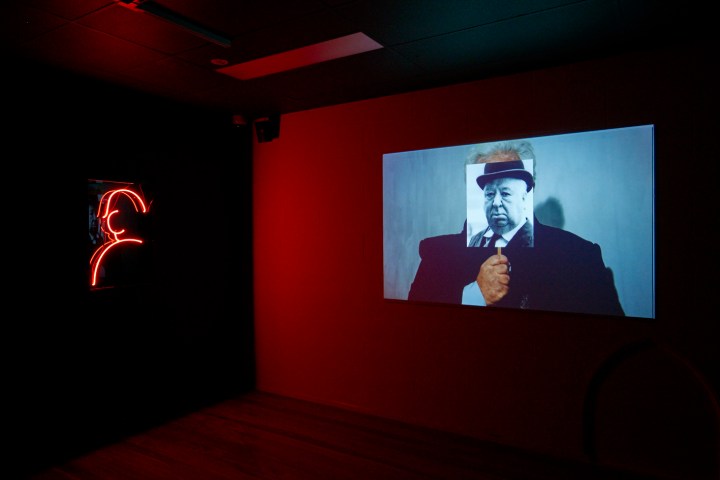
Conomos Hitchcock_20

The photograph : credit : Tim Connolly, Sydney, 2016.

Video and neon installation “ Paging Mr Hitchock” ( John Conomos, 2015)

“One Never Arrives.”

As one gets older one values our common world of aesthetic, cultural , dialogic and existential possibilities.

Art, writing, are in the final essence, shadows on the wall of life. Friendship above all these two any tick of the clock. But they are vital shadows that critically illuminate our lives.

When Friedrich Nietzsche, one of our enduring light – keepers, once said : “ Should life rule knowledge and science, or should knowledge rule over life ? Which of these two forces is higher and more decisive ? No one would doubt : life is higher, the ruling force, for any knowledge that destroyed the world simultaneously destroy itself .

Knowledge presupposes life, hence it has the same interest in the preservation of life that every creature has in its own continued existence.”

How many of us have taken heed of Nietzsche’s words ? How many of us as artists, academics, curators, writers and spectators are not clambering over each other in the name of careerism, self-interest and narcissism.

All of us, some more than others, are complicit – in the Sartrean sense – with the engulfing global free-market ideology that is seeping into our universities, museums, cultural institutions and industries. This is not new news, as we all know. It is just that reflexive knowledge, and self- and institutional critiques are rapidly receding into oblivion.

 What we are encountering, day by day, is a vertiginous global world of panoptic Fordism. Which is exceedingly fracturing Antoine de Saint – Exupery’s apt description of the world we have familiarly known as one being of winds, stars and tides. No time for such a world as we are too busy, too busy, in our public and private lives.

A few years ago, Jean-Luc Godard went to New York by plane from Europe and on his way back he chose to return by boat. Asked why he took the boat Godard replied : “ To see an open sky.” How many of us today see an open sky ?

One makes images and words because it is the only way one knows how best to interact with this world. One is compelled to do so. It is a vocation.

It is that simple and that complex. As John Cage use to say, rather enigmatically, “ nothing more, nothing less.”

One is also obliged to treat the past, the present and the future as one continuing dialogue of possibilities. Being alive to our one shared world. Treating the past as part of the present, in other words, believing in (to use Octavio Paz’s words) “ an antiquity without dates.”

In the late 1970s Susan Sontag was once asked what is the role of an artist or a writer in modern society? Sontag, who certainly lived up to her following words, replied that it was to pierce the narcotic veil that society produces on a daily basis and to show the possibilities of another world.

Art must be an invitation to contemplate the presence of beauty and the sublime in our lives as spectators, as artists, and as citizens. It is only in recent memory that beauty itself has been re-introduced into the discourse of contemporary art. Whether we speak of analogue or digital art both can be impoverished unless we are willing to acknowledge beauty as one of the definitive aesthetic, cognitive and ethical forces in today’s world.

To speak of beauty and the sublime as Edmund Burke, Immanuel Kant and others spoke of it as a co-mingling of awe and terror is to be willing to explore the enduring impact that they have in the literary, dramatic and plastic arts.

When our eyes encounter beauty are we compelled, as Ludwig Wittgenstein once argued, to want to draw it ?

Beauty matters in so many uncharted telling ways. Not least, as Elaine Scarry has recently demonstrated, because it is first of all sacred, it is unprecedented, and without sounding too melodramatic about it, it can be lifesaving. Whether it is Homer, Plato, Dante, Augustine or Proust, all of them averred that beauty quickens the beat of our hearts, makes life more vivid and worthwhile living. In essence, beauty greets you when you encounter it and indeed underscores the immense gift that life is.

It is also a calling to ponder the fragility of our material world and to seek , in a democratic civil society, that aesthetic fairness as well as ethical fairness are shared and central to human perception. Finally, it behoves us, in our universities, museums and schools that the beautiful artefacts of the people in the past are, as Scarry rightly notes, carried forward over to people in the future.

As artists and writers, one needs to be appreciative of the unwavering necessity to be aware of how many different kinds of cultural, linguistic and psychic borders, one crosses in their lifetime. It was Kafka who once described his nocturnal feverish writings as an act ‘of interior emigration.

The most direct route to the past and the present, knowledge and ethics, critique and poetry, is the one that roams freely across the ‘compartmentalisation’ of everyday life, that gets you from one point to another, that allows you to geographically and intellectually trespass, is the indirect one. Where everything is, to echo William Blake, connected to everything else.

 A sense of place has also been always dear to one. Landscape as lifescape, soundscape, tastescape, and memoryscape. Landscape as dis-location. Landscape is, as one sees and hears and interacts with it, something that lies, to evoke Jean-Francois Lyotard, ‘beyond the cultivated zone.’ Beyond the law of genre.

The dramatic global changes in capital, power, media and technology have wrought –- new aesthetic, cultural, epistemological and ethical shifts in how we define landscape, community, home and place.

 We need also to remind ourselves that the critique of cultural amnesia as a mass-mediated malady of late-capitalist culture is not new in itself – for example, witness Theodore Adorno’s, Walter Benjamin’s and Martin Heidegger’s inter-war writings on culture’s obsession with memory and the fetish quality of mass cultural forms. This is an important issue that often blights our cultural and epistemological endeavours to discuss art, culture, history and technology shifting in our ever – changing techno-culture.

Critically, then, cultural amnesia is paradoxically conveyed by our computer – inflected media in our age of consumption, information-networks and global capital.

To speak of one’s own art and writing practice is always a difficult thing to do in the light of D. H. Lawrence’s wise cautionary observation “ Never trust the artist, trust the tale”.

For one is critically concerned with questions of seeing and hearing which maybe hovering beyond our present horizons of creative, cultural and existential possibilities. Neither here nor there, so to speak, but yonder. But as we do, as Siri Hustvedt once reminded her readers, one ‘ can never find themselves yonder .’

There is the rub : art and writing, for us , share a perennially nagging, half-glimpsed, striving towards an undecided elsewhere ( Maurice Blanchot/Hugh Kenner/Ezra Pound). One never arrives.

Art that questions itself and articulates an overall attempt to be self-reflexive, open-ended, always motivated to remind ourselves that art is power and it needs to be always ‘untimely’, to put in Friedrich Nietzsche’s term.

Creating as a polemic with our time-haunted world.

By existential necessity one is – what you would call in the classical European sense of the term – a ‘ ragpicker.’ Or if you will, an ‘aesthetic vagabond’ (Jean-Louis Schefer) interested in the multiplying ‘creative encounters’ (Deleuze ) that have been and are taking place between art, cinema , video and the new media technologies.

Concerned with the conversations that exist between these different art forms, contexts, and genres. Locating the ancients next to the moderns in the same room and seeing what may ensue?

Through cunning, language, mimicry and play one learns to value beauty, difference, exilic marginality, self-reflexivity and experimentation in order to survive, to make sense of one’s ongoing life.

You cling to experience, feelings, intuition, smells, and passion, as well as colour, form, genres, texture, space, fragments, essays, aphorisms, quotes and digressions like a marooned sailor does to floating wreckage.

One’s past, identity, and self is intimately predicated on place, gender, history, memory, and time. This means absurdity, irony, scepticism, solitude and vulnerability.

Rilke’s central belief that the artist or writer is the bearer of cultural memory will increase in importance as this century unfolds. Making memory matter.

Art-making (irrespective of the medium) as a fugitive, elliptical enterprise that questions one’s own aesthetic, cultural and epistemological values.

The artist and writer as self – interrogator, as trickster, crossing the thresholds of multiple forms. Always attempting to dig deep , mingling things, perennially engaged in boundary creation and boundary crossing.

Forever curious, sceptical and suspicious of things especially of the continuous prison-houses we create and incarcerate ourselves in the name of art, cinema, culture, knowledge, and society.

Having an unswerving willingness to leave the beaten path.

Art as a form of ‘travelling without a passport ‘(Steve Fagin) , or as the French would say, being ‘paperless’- homeless, ‘without (identity) papers.”

Engaged in critical speculative enterprises, located at the edge, always in the midst of things, suspicious of homogeneity, fetishisation and linearity.

To make visible the invisible, to say the unsayable, you need to be bold in your convictions, recalling Cocteau’s wise counsel “ Art is worthless in my opinion unless it be the projection of some ethic. All else is decoration.”

This means that the artist and writer of this centur, like in the last one, will need to cultivate a fluid capacity to approach complex subjects with lightness, speed and simplicity.

Above all, art that is being forged on the today’s anvil of mutating techno-creativity, space , time , class, gender, power, and spectatorship, needs to always resonate to the telling wisdom of Cezanne’s following observation : “ Things are disappearing. If you want to see anything, you have to hurry.”


John Conomos, Sydney, I July 2016.

Associate Professor, Principal Fellow, The Faculty of Victoria College of the Arts and the Conservatorium of Music,

University of Melbourne.