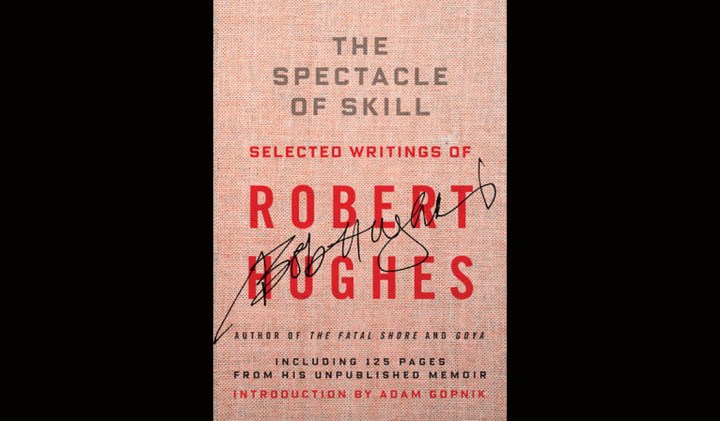
While we’re not usually into the cut and paste action straight from other blogs, this one has raised some particular interest worth sharing. Blouin Artinfo documented some ideas on the recent release of late Australian art critic Robert Hughes’s publication The Spectacle of Skill. A sobering read and straight hitting from number 1. Enjoy.
1. On What We’ve Lost: “What has our culture lost in 1980 that the avant-garde had in 1890? Ebullience, idealism, confidence, the belief that there was plenty of territory to explore, and above all the sense that art, in the most disinterested and noble way, could find the necessary metaphors by which a radically changing culture could be explained to its inhabitants.” (From “The Mechanical Paradise.”)
2. On Julian Schnabel: “He has been propelled by a manic, painfully sincere belief in his own present genius, and in his future historical importance. Between writers and readers, this lapel- grabbing has dubious value as a promotional tactic; in any case, it never works for long. (After their second books, who will persuade the discriminating reader that anything worthwhile will ever come from Jay Mclnerney, Tama Janowitz, and the other Bright Young Things of lower Manhattan, whose media-struck careers so closely resemble Schnabel’s?) But the American art system is more plagued by inflation, and more vitiated by fashion, than the American literary world. A book confers no status on its owner; a painting may. There is a crack of doubt in the soul of every collector. In it lurks the basilisk whose gaze paralyzes taste: the fear that today’s klutz may turn out to be tomorrow’s Picasso. Thus nothing except the manifestly out-of-date may be rejected with impunity. This hardy little reptile was particularly active at the moment Schnabel came on the scene. In the first half of the 1980s, riding the bull market, the demand for hot, young, new, exciting, contemporary art shot through the ceiling. All of a sudden, scores and then hundreds of the very new rich—arbs, developers, soap-opera producers, agents, admen, all manner of important folk whose uncertainty in cultural matters matched their socioeconomic vanity—decided that, being amply entitled to Everything Now, they would also become “major” art collectors. (From “Julian Schnabel.” This essay was originally published as “The Artist as Entrepreneur” in The New Republic, where, curiously, the phrase “Bright Young Things” instead appears as the far funnier “Bright Young Dwarfs.”)
3. On Clement Greenberg: Hughes carpet-bombs Clement Greenberg (and others) in the memoir-section chapter titled “Graft—Things You Didn’t Know,” and it’s impossible for one passage to summarize the charges of rampant nepotism and quid pro quo he levies. Beyond the above-mentioned situation with the Sullivanian “cult,” Hughes details an episode in which Greenberg, as a trustee of the estate of David Smith, took it upon himself to have several of his sculptures posthumously repainted. Greenberg was also a wheeler-and-dealer in the artists he critically endorsed, much to Hughes’s chagrin: “[Greenberg] didn’t write enough to earn a living. He seems to have subsisted largely on gifts to him from grateful or hopeful artists, plus retainers for his services as adviser from various art dealers, notably the firm of French & Co. in New York. There were lecture fees, too—though in the 1960s and ’70s these were low, since museums and universities didn’t pay their speakers at all well, and few could command as much as five hundred dollars for an appearance. Revenues from book royalties were trivial; they would not have kept a mouse in breadcrumbs. The real living was to be made in art dealing, whether in an open or a disguised form. Greenberg hardly bothered with disguises. He didn’t believe in buying art, but he liked receiving it. He thought he had a perfect right to be compensated by artists for his recommendations of their work, and by art dealers who sold it with the help of his opinion. So in a sense he had, because there was certainly nothing illegal about it; the whole domain of relations between artists and critics, critics and curators—indeed, of everything that bears upon the art market and its insiders—was then and largely remains today an ethical slide area.” (From “Graft—Things You Didn’t Know.”)
4. On Andy Warhol and Self-Promotion: “Warhol was the first American artist to whose career publicity was truly intrinsic. Publicity had not been an issue with artists in the Forties and Fifties. It might come as a bolt from the philistine blue, as when Life made Jackson Pollock famous; but such events were rare enough to be freakish, not merely unusual. By today’s standards, the art world was virginally naïve about the mass media and what they could do. Television and the press, in return, were indifferent to what could still be called the avant-garde. ‘Publicity’ meant a notice in The New York Times, a paragraph or two long, followed eventually by an article in ARTnews which perhaps five thousand people would read. Anything else was regarded as extrinsic to the work—something to view with suspicion, at best an accident, at worst a gratuitous distraction. One might woo a critic, but not a fashion correspondent, a TV producer, or the editor of Vogue. To be one’s own PR outfit was, in the eyes of the New York artists of the Forties or Fifties, nearly unthinkable—hence the contempt they felt for Salvador Dali. But in the 1960s all that began to change, as the art world gradually shed its idealist premises and its sense of outsidership and began to turn into the Art Business.” (From “Andy Warhol.” This well-known essay was originally published as “The Rise of Andy Warhol” in the New York Review of Books.)
5. On the art market: “The art market we have today did not pop up overnight. It was created by the great liquidity of late-twentieth-century wealth. Sell a block of shares, shift the money elsewhere. But liquids do not flow where you want them to unless you dig channels, and this patient hydraulic effort has been, since 1960 at least, one of the wonders of cultural engineering. The big project of the art market over the last twenty-five years has been to convince everyone that works of art, although they don’t bear interest, offer such dramatic and consistent capital gains along with the intangible pleasures of ownership—what Berenson might have called “untactile values”—that they are worth investing large sums of money in.” (From “Art and Money.”)
6. On Collectors and the Power of Critics: “People speak of the ‘power’ of critics. In my experience such talk tends to be exaggerated, often very much so. What’s more, it only applies to certain arts. Books, for instance: most people can be jogged to buy a relatively cheap commodity like a book — less than $5.00 as a rule — by reading an enthusiastic review, especially if it’s written by someone whose work and taste the reader trusts. It is the same with movie reviews: though movie tickets cost far more than they used to, going to the movies on some critic’s say-so isn’t much of a financial gamble. (I leave on one side the deluded souls who base their cinemagoing habits on whether a pair of chatterboxes on network TV express themselves by sticking their thumbs in the air up or down — a gimmicky reduction of the critical act to the most primitive binary sign language.) … If anything, critics don’t attract, they repel. Indeed, The New York Times has the fearsome, and seemingly deserved, reputation of being able to sink a Broadway show, stone dead, with a single review. One torpedo, sprung in the engine room. Manifestly, no publication has or could have that kind of immediate influence over art exhibitions or (especially) over art sales. Many collectors are philistines, and their numbers grow as the collector population expands; but although some of them can be prevailed on by dealers to buy the most implausible or even outright ridiculous things for their collections, and though many of them are little more than fashion victims whose tastes are dominated by the herd instinct, few of them are complete nitwits when it comes to money.” (From “Coming to ‘Time.’”)
“The Spectacle of Skill: New and Selected Writings of Robert Hughes” was published by Knopf on November 17.



 RAYGUN