Friday night was lots of fun at RAYGUN and thanks Andrew for showing with us.
comment 1
Friday night was lots of fun at RAYGUN and thanks Andrew for showing with us.
Come check out Fritz Haeg’s Artist Talk, April 19th @ Weatherspoon Art Museum, 4-5pm, Greensboro, N.C., USA
I saw him speak at Open Engagement last year and it really inspired me to hear about The Sundown Salonand Edible Estates I’m currently engaged in two seperate projects based on these ideas. My opinion is obviously pro-Haeg. I hope you can make the talk.
Check out more about him at big think –
thoughts by the artist
Hope to see you there,
Sam Peck
“Diplotopia takes its point of departure in the American magazine Whole Earth Catalog (1968-’71) and their belief in the revolutionary potential of Nasa’s first image of the globe from 1967. The photograph became the outset for the aesthetics of the magazine and in a later issue (Fall ’70), a pastiche of this very picture made the cover.The title ‘Diplotopia’ is a combination of utopia and diplopia, which means double vision, and by unfolding the ideologies and images from the magazine, the video plays out a science-fiction scenario wherein the revolutionary potential of the photograph(or was it actually the pastiche photograph?) came to have an impact on the world which has led to a whole different society from the one we know today.”
In May RAYGUN will be showing video work by Danish artist Honey Biba Beckerlee. Ali and I watched the video DIPLOTOPIA this morning and were seriously wowed. Here are some words from Honey about her work.
Diplotopia takes its point of departure in the American magazine Whole Earth Catalog (1968-’71) and their belief in the revolutionary potential of Nasa’s first image of the globe from 1967. The photograph became the outset for the aesthetics of the magazine and in a later issue (Fall ’70), a pastiche of this very picture made the cover.The title ‘Diplotopia’ is a combination of utopia and diplopia, which means double vision, and by unfolding the ideologies and images from the magazine, the video plays out a science-fiction scenario wherein the revolutionary potential of the photograph(or was it actually the pastiche photograph?) came to have an impact on the world which has led to a whole different society from the one we know today.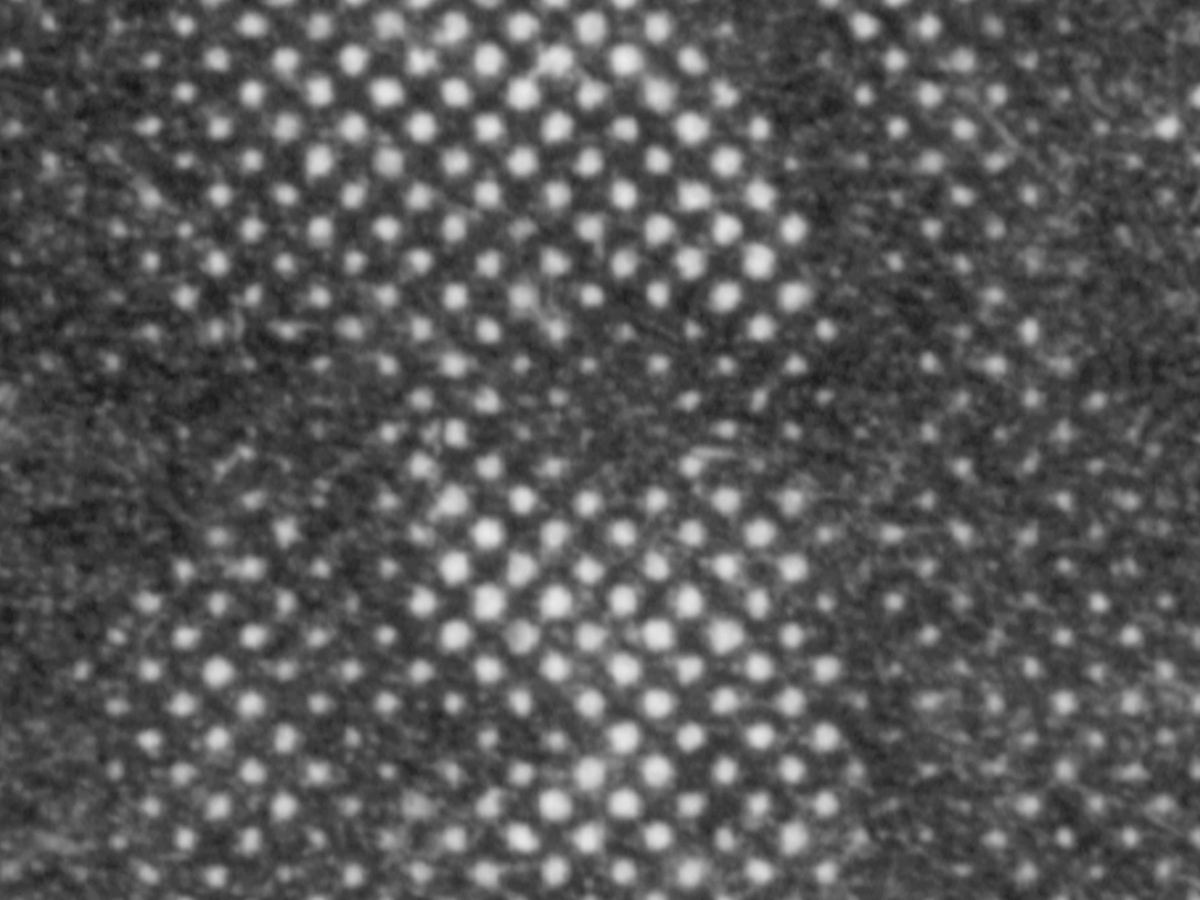
A part of Uffe’s show includes three topiarie plants. On Uffe’s first day we went out to Bunnings hardware to purchase some pots. Yesterday Ali and Uffe did some gardening and re potting back at RAYGUN – They kind of give the space a homely feel and after the show they will be transplanted into the ground out at the University.

Andrew Macdonald’s upcoming show at RAYGUN on Friday 13th April will make for some intriguing viewing and handling.
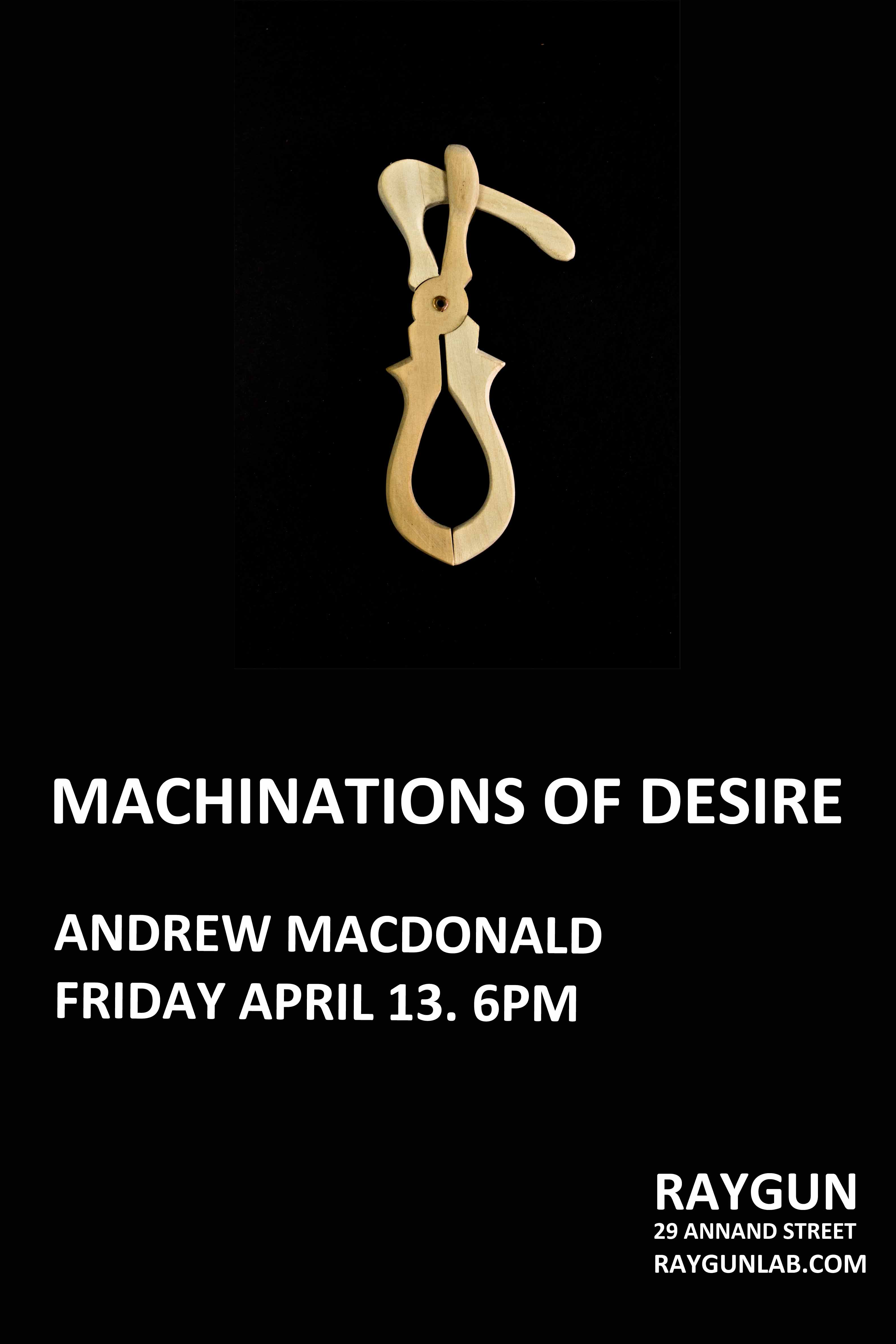
Machinations of Desire
DESIRE- Object of want, yearning; lust for another. The reverse, to be wanted in return. Therefore reciprocal.
RECIPROCATING- Give and take, backwards and forwards, up and down. The ubiquitous reciprocating mechanism, the internal combustion engine with its piston and cylinder, and the basic MACHINE used as sexual imagery.
MACHINATION- the use or construction of machinery; to contrive or construct; a plan, plot, or intrigue; to scheme.
DESIRE is tied to MACHINATIONS. From the start- the flirting- the plot is enacted, the strategy of seduction, to the physical culmination: an intrigue with intent and outcome, contrived or constructed, machinations of desire.
How to express the essence of DESIRE using sculptural form, while trying to avoid text or representational imagery:
To map the stages (dare to call it the plot) of a relationship, from nascent desire to consent, to the aftermath, by a form that encapsulates intent, action and result. A simple machine, an instrument- musical, surgical, or metaphorical- with the intrinsic manual component: to be handled, to be tactile and sensuous. Instruments are tools: extensions of the hand, an extension of reach, a multiplier of capabilities, empowerment.
The phallic manifestations of desire, with little ambiguity but sensuous enough not to alienate, to seduce. Made in solitude, erotic reverie; patient, serial acts of unrequited lust, meditating with tools. Concrete, palpable experiments of the external, formed with their opposite as reference.
The hand-cranked (with the obvious connotations) allows an empowerment in the act of making the move; change the situation; imposing your vision or arrangement. The body, more specifically the hand, determines the view, and thereby reinstates the primacy of the body. And a complicity of working with the maker, not simply participating but colluding.
I attended the lecture by Richard Mosse at the Weatherspoon Art Museum on Thursday of last week. He presented photos made with a large format camera, 8 x 10 and sometimes a hand held using infrared film. This use of technology (the film) previously used for military purposes concerning how to locate enemies that were hidden by camouflage and cameras that allow for the greatest detail in each negative are an innovative choices for a photographer.
Mosse’s use of the film effects how one reads the photo. Questioning what you see because of the odd blues, pinks, and purples that make up these other wordly photos. Content demanding deeper inspection and scrutiny. Mosse talked about believing in questioning what one sees in the still image. He presented his photos as narratives in the same line as Western history paintings. He showed the image of The Raft of Medusa at the Louvre.
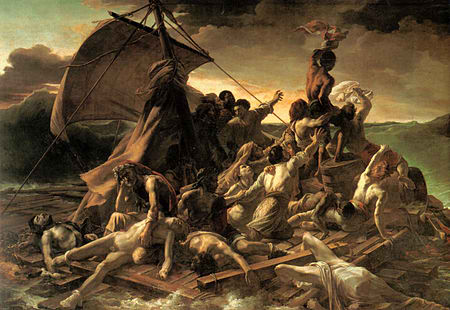
The Raft of Medusa
With this connection comes the question of the validity of his images as true. A question is then posed; as documentary photographer is his job to show us the truth?
He spoke at the beginning of his talk about what he saw that photography was. Starting with a work by Chris Burden
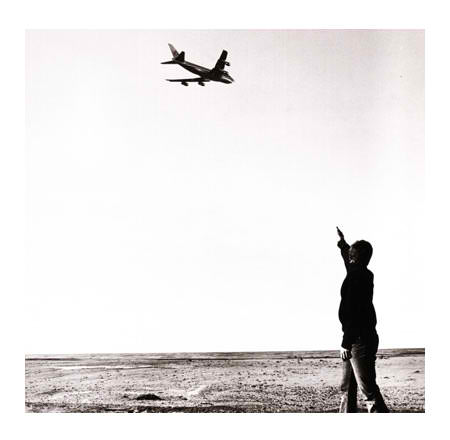
Mosse discussed how Burden was able to do something so simple, shoot a pistol at planes a mile and pre -911, to discuss a larger idea, terrorism. He praised Burden at what ease this work seemed to come about and transmit ideas. Mosse went on to talk about the Greek god Prometheus and the Norse god Loki. Both of these figures were strapped to rocks for all eternity for their transgressions against their fellow gods. Mosse said in much the same way photography and conceptual art hold positions on the same rock or place within art, maybe just in different places on the rock.
During grad school Mosse made small narratives from a series of found objects from the US/Mexico border. He moved the artifacts to get a stronger composition and story. Mosse had no qualms with this because he said that his art demands a beautiful image and a great story.
The photos themselves were beautifully printed and presented.
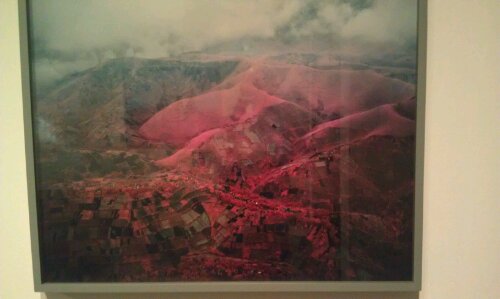
I snapped a photo of the image above, whose landscape was described in the lecture to be “Seussian” by Mosse himself. Now the sculptured landscape forms within the photography are questioned as well. The line between the real and the unreal is called into by Mosse with every turn of the talk.
Overall I felt that Mosse is asking us to question what we see in his work and to take these ideas and apply them to the larger world. Asking us in our everyday experience to question the news headlines journalist’s show and tell us, those “well groomed” stories.
– Sam Peck
 RAYGUN