comment 0
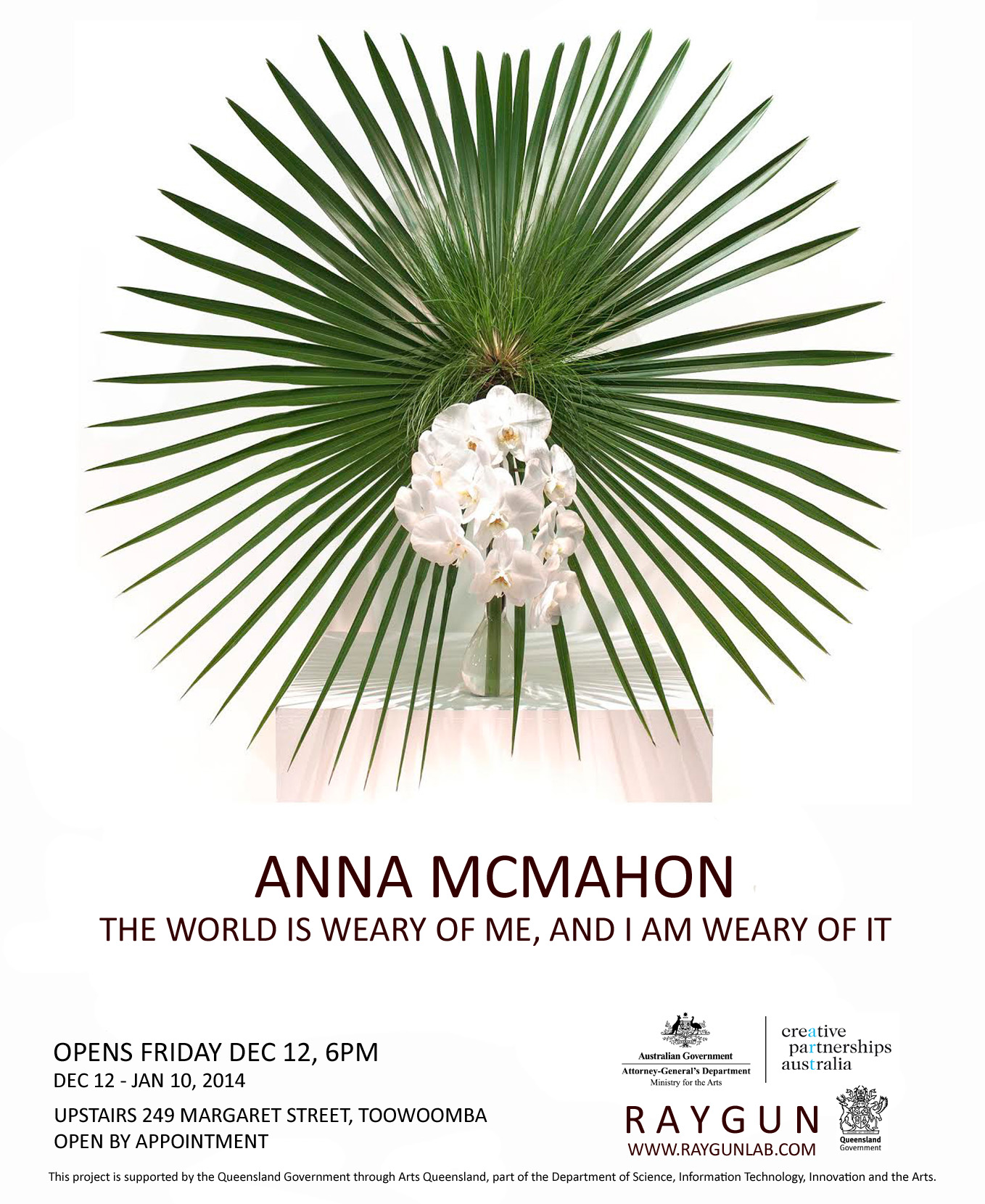
Anna McMahon
Thanks to guest speaker Dr Kyle Jenkins who discussed the work.
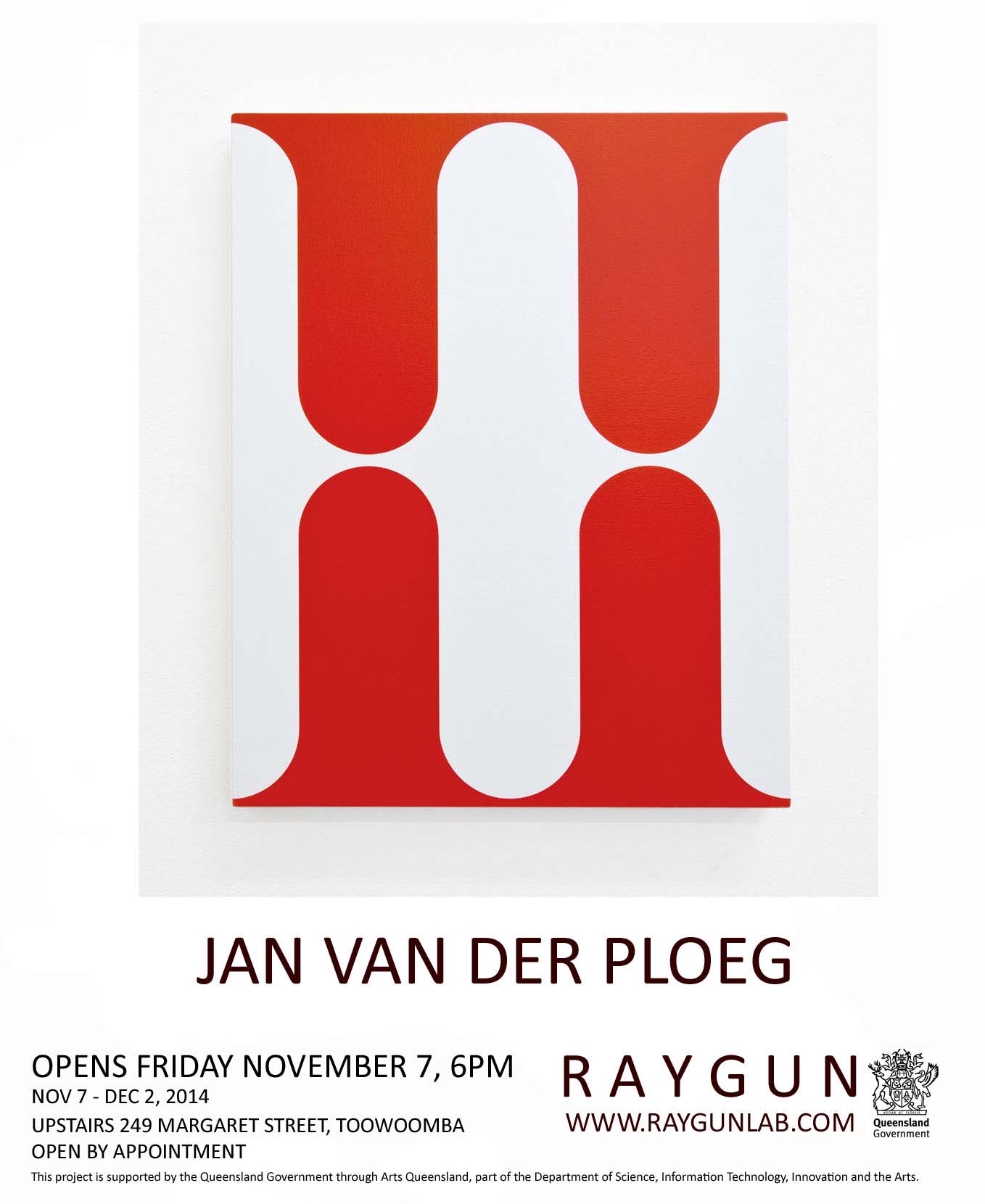
Jan Van Der Ploeg Interview with Tarn McLean for RAYGUN 2014
Tarn – What ideas are you examining through your exhibition at RAYGUN?
Jan – With the design of the wall work I sent, I look at the space and try to imagine how it is if I was to be there, and try and get an idea of the space by looking at the site and other exhibitions that have happened before me, and then to come up with an idea the would be best.
Also in principle terms it is because I am not physically going to be there to make the work that it should be designed to be made by some one else and Kyle Jenkins has a lot of expertise to do that job, but maybe he will ask you to do it, or other art students. They’re a few things that I keep in mind when designing.
In a broader sense it is a very long story when I make a work, what I make the design for, and maybe that’s something we can discuss another time but for now it is to work with the space and also the work is abstract and not an abstraction of something, and I leave space for the audience to look at it and visualize something for themselves, or to think about what it could mean to them. And so the design that I sent you could be read as an abstract shape, or maybe as text or maybe as to a lot of things, and it’s open to the public to decide for themselves.
T – What are the ideas that surround your work or practice? Let me expand on that and focus on the question in regards to you specifically being a painter: would you think about answering that in terms of non-objective practice?
J – Yes, my work often is related to, or gets shown in spaces that have non-objective in their name like in Australia the Australian Centre for Concrete Art, or in Brussels the Centre of Non Objective Art. My work is abstract but I don’t refer to it as concrete or non objective like the spaces write about, or think about, because concrete art is something that started in the 60’s and while the pure concrete art is really interesting it can also be really boring and hopefully my work is not boring. With my work I try to make people happy or feel optimistic or positive. In regards to are the ideas that surround my practice it think my preference is making both wall paintings and making small works on canvas. I look at them [to be] the same, although some people may experience them as something else. A small work on canvas is of course something quite different to when a whole building that you’re in, either on the inside or outside, is painted.
T- Would you say then that the intentions that you put on a canvas would be transferred across over into the design of space and architecture through the work that you do, like the wall paintings, do they come from the same intentions?
J- Yes, intentions yes, It’s not that I would copy a small painting in to a big wall painting, I really see them as individual works, but the intentions can be very much the same.
T- I’m trying to situate where contemporary painting is today; how we do other things other than just painting on canvas. You design space, you reference architecture so I’m saying that I see the things that you do as where painting is situated today, and that is it’s expanded over into other different things, it’s not just the one, painting is multiple things.
J- I agree, I mean 30 years ago when I started art school the question to an artist was always what do you do? Are you a painter or a sculptor? Was it painting or sculpting? And now its so many other things, being a painter now means so many other things.
T- Do you know why? Do you think about technology, culture….?
J – I do, but you can’t really read that in my work, you can’t really look at my wall painting and say ‘oh Jan must have been thinking about something political’, I try to not make any political statement directly in my work. But in a different way I have to consider technicalities, I have to do some research in to the material, for example if I sell a work I have to make sure it doesn’t fall off the wall a few months later, and so I do learn about painting, about what I can use or should use in certain circumstances, like if it has to be made with steel or concrete, if the walls are wood or indoors or outdoors…
T- Maybe it’s those physical things that keep extending you practice?
J – Yes, but really that’s of minor importance because the work has to be technically OK, but then as soon as I have worked those technicalities out, that is when I forget about them and focus and concentrate on what it is that I want to make, for example if it’s going to be colour or just black and white, as in the design for RAYGUN.
T- What are your influences or other interests?
J- Influences, that can be everything, I mean when people write texts on my work they will mention a few names of artists, like those (Dutch artists) associated with the De Stijl movement, Piet Mondrian, Gerrit Rietveld and Theo van Doesburg, they are often mentioned, and more recently people like Richard Artschwager or Sol LeWitt. Maybe that’s very obvious that I look at these kinds of works but often my discoveries or my inspiration just comes from the street, not so much from art history but more from what you might find on the street, for instance what you see someone wearing, often it can be motifs that are used in design or in fashion or what ever, it’s really open. When I first started to give lectures about my work I would always start with images of Pler Della Francesca, a 14th Century painter and to explain what I like about that work and especially one painting Madonna del parto which was painted for a small church in Monterchi, Italy. It’s interesting that people don’t expect that I also look at this more classic painting, but really the influences can be anything.
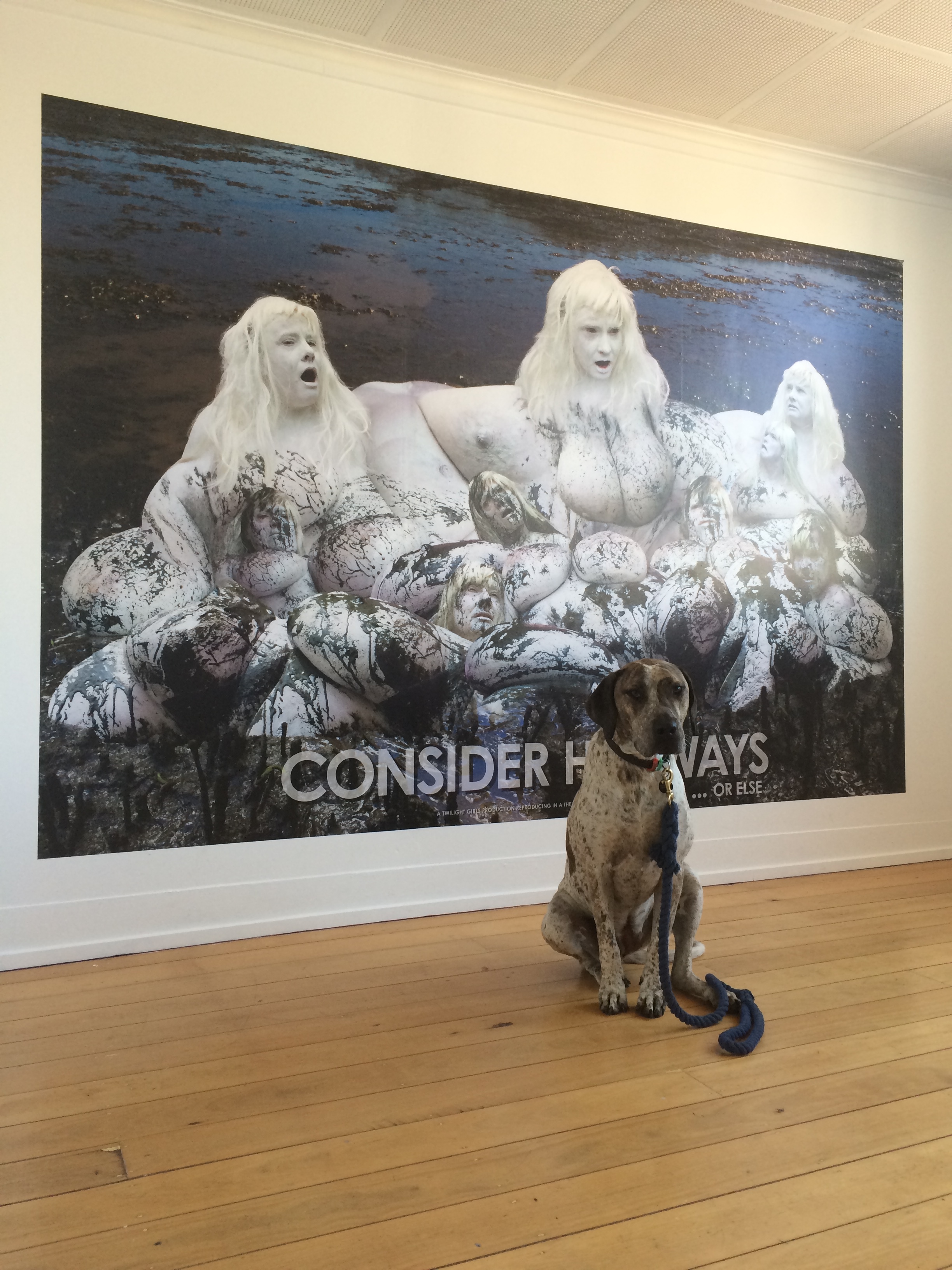
In Toowoomba we have different artist run spaces that all offer different things. One in particular we love is No Comply. It’s tied up with organising awesome shows with artists who are super keen and talented in the local and global Street Art scene. Today at RAYGUN we were visited by No Comply’s Directors Grace Dewer and Princess Polly, they were introducing their current artist Ben Reeve to the sights of Toowoomba before his opening tonight. We asked Polly (we’re on a first name relationship, no titles required), if we could take a few gallery shots of her this morning as there was some serious colour co-ordinating going on between the Twilight Girls’ work and her own attire and accessories.
Thanks Polly xx
Taking a side trip from the current show theme and looking again at the Artist Run space from last month, it’s time to mention the project TEKSAS in Denmark, co-directed by artists Peter Holm and Karin Lind. While visiting Copenhagen in May for the Artist Run Festival I took a trip north to meet Peter for research and was lucky enough to be welcomed in to their beautiful home which also houses their artist run space TEKSAS.
It is attached to their home, along with multiple studio’s and open living spaces, and as an extension to the gallery they even have a wall painting project that is installed in the paddock nearby. I think heaven on earth is in this place. In between working on their own practices they invite specific artists to show in the gallery who’s work they feel have significantly contributed to the history of art, specific to its genre. Check it out.
This is a fantastic artist talk – Helen Hyatt Johnston speaking about the show ‘Consider Her Ways’ and The Twilight Girls on behalf of Jane Polkinghorne.
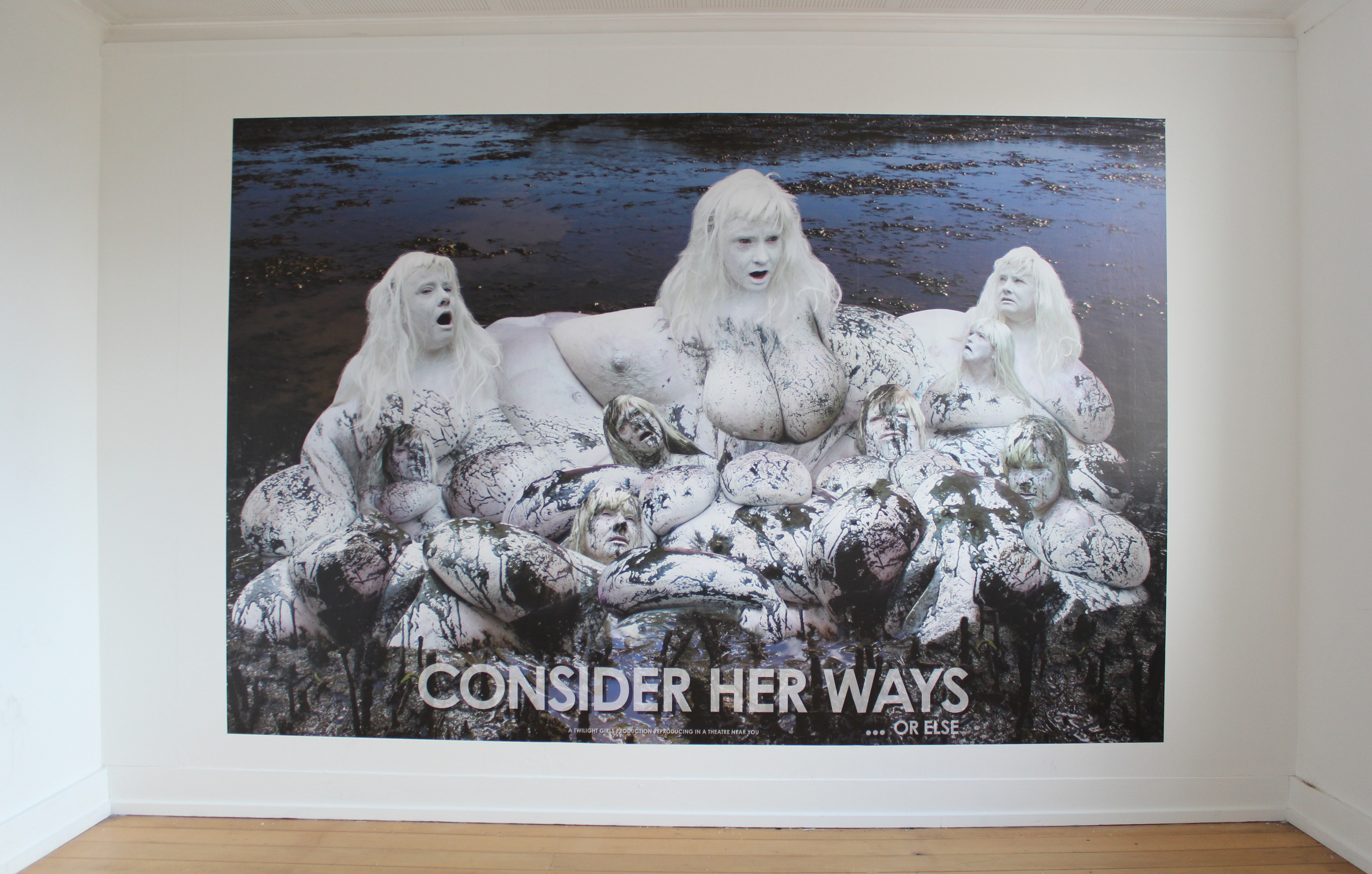
Last night RAYGUN had the pressure of presenting The Twilight Girls, collaborative duo Helen Hyatt-Johnston and Jane Polkinghorne. The was a great opening. Helen was a smash, and spoke brilliantly about the work! Below are the images from the opening and The Twilight Girls contribution to their catalogue. If you missed the opening please do pop up and see the work x
Consider Her Ways
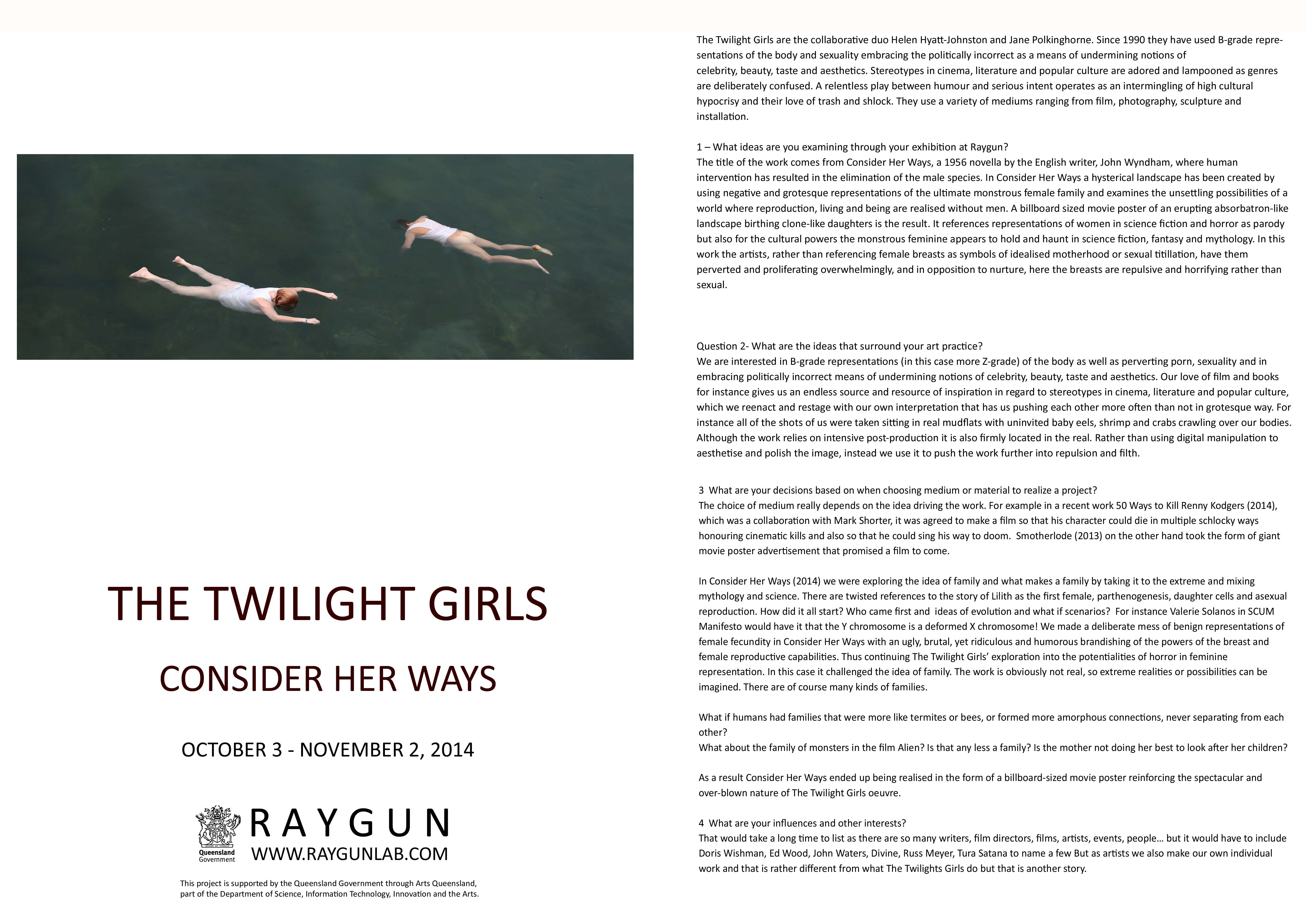
The Twilight Girls are the collaborative duo Helen Hyatt-Johnston and Jane Polkinghorne. Since 1990 they have used B-grade representations of the body and sexuality embracing the politically incorrect as a means of undermining notions of celebrity, beauty, taste and aesthetics. Stereotypes in cinema, literature and popular culture are adored and lampooned as genres are deliberately confused. A relentless play between humour and serious intent operates as an intermingling of high cultural hypocrisy and their love of trash and shlock. They use a variety of mediums ranging from film, photography, sculpture and installation.
1 . What ideas are you examining through your exhibition at Raygun?
The title of the work comes from Consider Her Ways, a 1956 novella by the English writer, John Wyndham, where human intervention has resulted in the elimination of the male species. In Consider Her Ways a hysterical landscape has been created by using negative and grotesque representations of the ultimate monstrous female family and examines the unsettling possibilities of a world where reproduction, living and being are realised without men. A billboard sized movie poster of an erupting absorbatron-like landscape birthing clone-like daughters is the result. It references representations of women in science fiction and horror as parody but also for the cultural powers the monstrous feminine appears to hold and haunt in science fiction, fantasy and mythology. In this work the artists, rather than referencing female breasts as symbols of idealised motherhood or sexual titillation, have them perverted and proliferating overwhelmingly, and in opposition to nurture, here the breasts are repulsive and horrifying rather than sexual.
2. What are the ideas that surround your art practice?
We are interested in B-grade representations (in this case more Z-grade) of the body as well as perverting porn, sexuality and in embracing politically incorrect means of undermining notions of celebrity, beauty, taste and aesthetics. Our love of film and books for instance gives us an endless source and resource of inspiration in regard to stereotypes in cinema, literature and popular culture, which we reenact and restage with our own interpretation that has us pushing each other more often than not in grotesque way. For instance all of the shots of us were taken sitting in real mudflats with uninvited baby eels, shrimp and crabs crawling over our bodies. Although the work relies on intensive post-production it is also firmly located in the real. Rather than using digital manipulation to aesthetise and polish the image, instead we use it to push the work further into repulsion and filth.
3 . What are your decisions based on when choosing medium or material to realize a project?
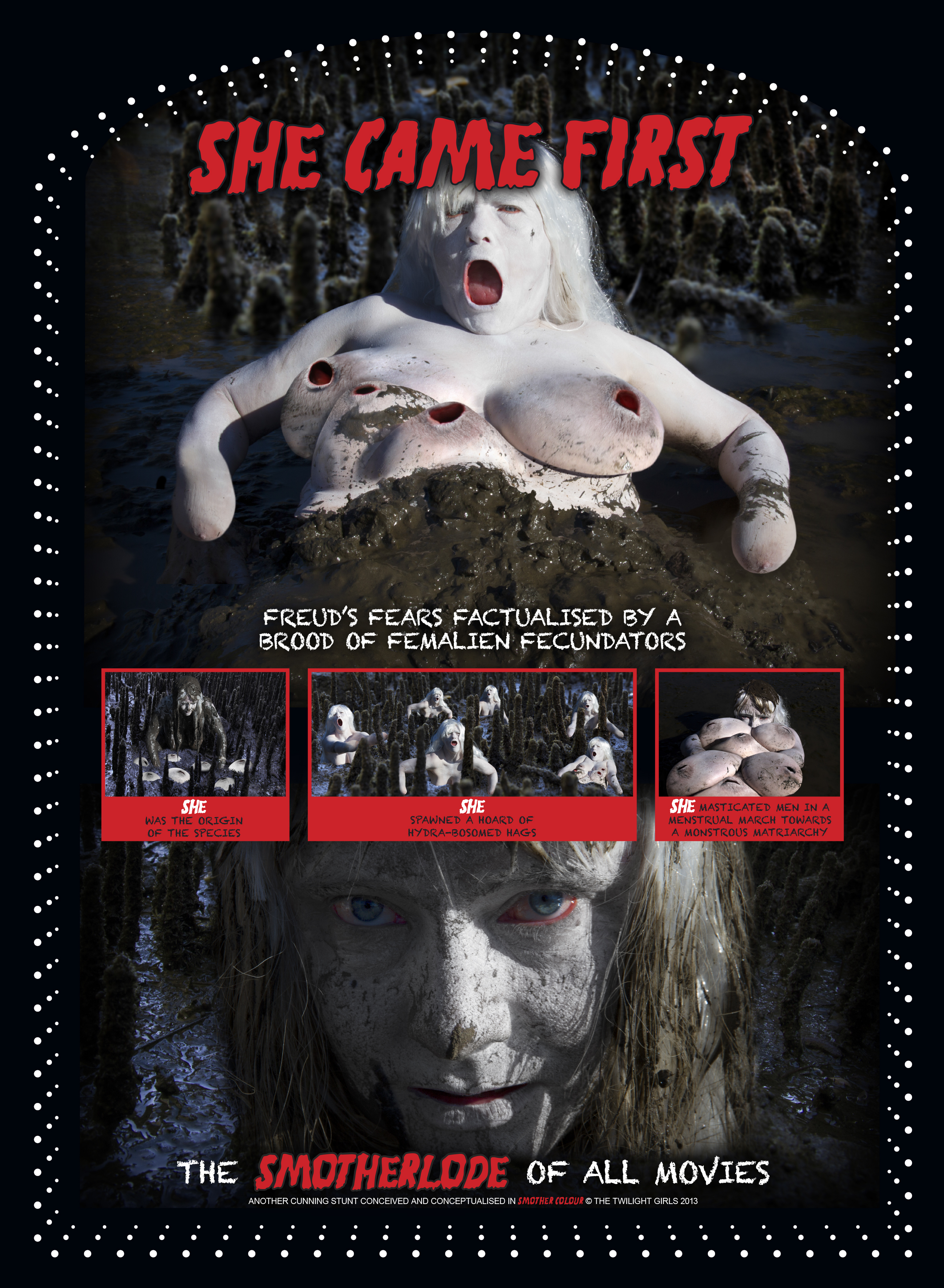
The choice of medium really depends on the idea driving the work. For example in a recent work 50 Ways to Kill Renny Kodgers (2014), which was a collaboration with Mark Shorter, it was agreed to make a film so that his character could die in multiple schlocky ways honouring cinematic kills and also so that he could sing his way to doom. Smotherlode (2013) on the other hand took the form of giant movie poster advertisement that promised a film to come.
In Consider Her Ways (2014) we were exploring the idea of family and what makes a family by taking it to the extreme and mixing mythology and science. There are twisted references to the story of Lilith as the first female, parthenogenesis, daughter cells and asexual reproduction. How did it all start? Who came first and ideas of evolution and what if scenarios? For instance Valerie Solanos in SCUM Manifesto would have it that the Y chromosome is a deformed X chromosome! We made a deliberate mess of benign representations of female fecundity in Consider Her Ways with an ugly, brutal, yet ridiculous and humorous brandishing of the powers of the breast and female reproductive capabilities. Thus continuing The Twilight Girls’ exploration into the potentialities of horror in feminine representation. In this case it challenged the idea of family. The work is obviously not real, so extreme realities or possibilities can be imagined. There are of course many kinds of families.
What if humans had families that were more like termites or bees, or formed more amorphous connections, never separating from each other?
What about the family of monsters in the film Alien? Is that any less a family? Is the mother not doing her best to look after her children?
As a result Consider Her Ways ended up being realised in the form of a billboard-sized movie poster reinforcing the spectacular and over-blown nature of The Twilight Girls oeuvre.
4. What are your influences and other interests?
That would take a long time to list as there are so many writers, film directors, films, artists, events, people… but it would have to include Doris Wishman, Ed Wood, John Waters, Divine, Russ Meyer, Tura Satana to name a few But as artists we also make our own individual work and that is rather different from what The Twilights Girls do but that is another story.
Check out this video ‘The Power and the Glory’ featuring The Twilight Girls, Helen Hyatt-Johnston and Jane Polkinghorn , we heard some of the wild incredible behind the scenes stories last night.
Tonight Helen joins us in Toowoomba for her opening CONSIDER HER WAYS by the Twilight Girls, an ongoing collaborative project between Sydney based artists Helen Hyatt-Johnston and Jane Polkinghorne. Yesterday Ali and I were lucky enough to view an ‘almost edited’ 25 minute film which is a further extension of this nearly 15 year collaboration and worth staying tuned for.
Below is a link to an essay written by Jacqueline Miller on the poster project by The Twilight Girls and the premise behind this ongoing work.
http://contemporaryartandfeminism.com/2013/10/22/essay-the-twilight-girls/
(essay sourced from contemporary Art and Feminism)
Jacquline Millner (1997-2002)
The ‘revolutionary power of women’s laughter’ became something of a cliché in much irony-clogged feminist work of the 1980s. While often smart and sparkling with caustic wit, such work rarely raised a belly laugh, provoking not so much laughter as rueful, knowing smiles. This is precisely the Twilight Girls’ distinction — a generous and raucous humour that overflows gallery etiquette. This is not private joke territory; the bad taste has a broad appeal, and it is infectious.
The Twilight Girls’ first major collaboration in 1997 featured six larger-than-life movie posters lining one wall of the gallery portraying the artists in various notorious film roles, with deliberately bad feminised/queered titles: From her to eternity, Saturday night beaver, One million years BB (before bras). The fantasy-realising world of cinema was also invoked in a series of putative lobby cards, where such queer icons as Elizabeth Taylor playing Maggie the Cat were lovingly mimicked. With the now relatively simple technique of digital graphics, the artists were able to envision their fantasies for public display, staging them within the space of the promotional film poster, that essence of the film that is distilled into a single shot and becomes emblematic of the film as commodity (and is also a lot quicker and cheaper to produce!).
Polkinghorne and Hyatt-Johnston openly acknowledge their debt to popular culture for their innermost personal identities and desires; film and commodity culture have permeated their core beings, and yet they are still able to mess that culture around, to tease and frustrate it with incredulity and insouciance, their playful evasion of any one category of sexuality being exemplary of their strategy. They cavort in the space of possibility that self-lampooning humour allows. The Neanderthal sexual politics of Saturday Night Fever are queered, as are the macho heroics of the Western genre (The Good, the Bad, the Chubby), while the sexploitative B-grade sci-fi of the 1950s is lovingly mined for its feminist subtext (Attack of the Big Top Beauty).

On the opposite wall, that quintessential 70s gadget, a record selector crammed with vinyl, offered a plethora of further opportunities to dress and crack up. In arguably the best resolved component of the exhibition, a series of faux album sleeves read like a roll-call of skewed genres, from opera (Big girls sing fat songs), to girl groups (The Tampettes), to world music (We are third world: proceeds from this album will go to feeding all the people in the world who weigh less than 65 kg)and more. The format allows for plenty of word-play, the artists relishing in the smutty song-title (‘How deep is your throat?’) as much as in spoofing the authority of critical album notes.
In a later work, part of Hollywood Hills made while the artists were in Los Angeles, a huge pair of breasts filled the gallery like a mammoth film set, not unlike the massive vengeful mammary that hunts down Woody Allen in Everything You Ever Wanted to Know About Sex but were Afraid to Ask (1972). They are like the built façade of femininity. Not pert but susceptible to the force of gravity, these pendulous organs are rendered in a size relative to the place they occupy in the popular image of femininity. Like Magritte’s manifesting of the unconscious in Le Viol (1934) (where the face of a woman is conflated with her breasts and sexual organs), this installation foregrounds the disproportionate part breasts play in female identity. These are the breasts not of your dreams but of your nightmares, of the Monstrous Feminine, of the implant gone berserk, of the desirable turned grotesque. As such, they might be dangerous…although the Twilight Girls always lace their danger with humour. This strategy does not take the edge off the point—the pervasiveness of the reductive practices of sexual stereotyping and objectification—but rather complicates it. For these girls enjoy that fetishising, partake of it, flaunt their large sets, build whole exhibitions around them and turn them into art. Polkinghorne and Hyatt-Johnston objectify their own bodies, fetishise their own breasts, buy shares in the commodification of their own body parts, not only to underline their complicity in that very process but also as a means of enjoyment. And they succeed in this where many other feminist artists have failed because through their humour and carefully selected mix of glamour and anti-aesthetics they resist trading on their own potential to titillate, keeping a loose hold on their own representation without ever becoming heavy or high-handed. And at the same time as they invite us to laugh and enjoy with them, so do they betray nothing of the irony of much art derived from popular culture. Instead, what is palpable is a certain pathos in the predicament of being reduced to the size of your body parts, an earnest concern for the plight that they and many women experience every day of their lives.
The Twilight Girls are conscious that their broad humour and constant gags serve to undermine their own efforts to become art/pop/film stars, for their public is never sure as to whether the artists take their own work seriously, or indeed whether they believe that things like art, film and celebrity are worth being serious about. And in a sense that is one of the driving forces of their practice, that relentless play between humour and serious intent, that desire to invoke in the viewer that curious moral space between carefree lampooning and critique. While the Twilight Girls openly embrace bad taste and politically incorrect B-grade (and below) representations of femininity, so they call attention to ‘high-culture’ hypocrisy, where lip service may be paid to feminine and queer empowerment but where the space for self-actualisation may be even more limited. Similarly, their flagrant self-commodification pulls into focus the absurdity of attempting to compete with or live up to the promises of popular culture, but also allows them the freedom to use those tools as means of self-expression. As the artists themselves put it, ‘Hollywood Hills continues our overblown corpse of a practice where the most overt and obvious signs of capitalism inflicted on flesh are wrought gigantic in an attempt to exhaust/explode/implode our own bodies into the world’.
Helen Hyatt-Johnston and Jane Polkinghorne have collaborated on a latter-day feminist project where the theory is but a distant subtext to the sheer pleasure of the process — a giggling late night game of one upmanship to hit upon the corniest pun, the silliest costume, the most outrageous scenario in which to cavort and vaunt of themselves. Popular culture feminine and heterosexual stereotypes are both lampooned and adulated, their glamour aspired to but at the same time mired in tack. This is a game without parameters, egged on by sleepless delerium and the untrammelled nature of adolescent fantasies of fame and stardom.
But the process meets maternal superego when it comes to execution. For the finished product here is nothing like the abject, formless detritus of some recent art vying to ‘represent’ femininity as excess. Rather, the work is formal and meticulous, without a hair out of place, the lipstick smudges quite deliberate; these girls have mastered their technology. The artists have faithfully reproduced the aesthetics of cinematic and popular music genres using studio shots and digital manipulation. Excess is instead evident in the hysterical number and diversity of mise-en-scenes the artists have chosen to act out, eclectic verging on arbitrary choices that suggest a potentially endless project. And excess is also, perhaps more intriguingly, evoked by the very process of collaboration, whereby the viewer is kept guessing as to where one artist ends and the other begins.
Hyatt-Johnston and Polkinghorne’s work is a hilarious celebration of the endless potential to personalise Hollywood fantasy so as to enjoy the vicarious glamour and tack without foreclosing either individual expression or the subversion of mainstream codes. The artists confuse genres and disciplines, feminist aspirations and sacred cows, in a mad comic brew that speaks more of the pleasure of play and friendship than of the construction of sexed identities. And this is the point, to evade the strictures of accepted feminist strategies by putting inclusive play back on the map.
Copyright Jacqueline Millner, 2002
The Twilight Girls
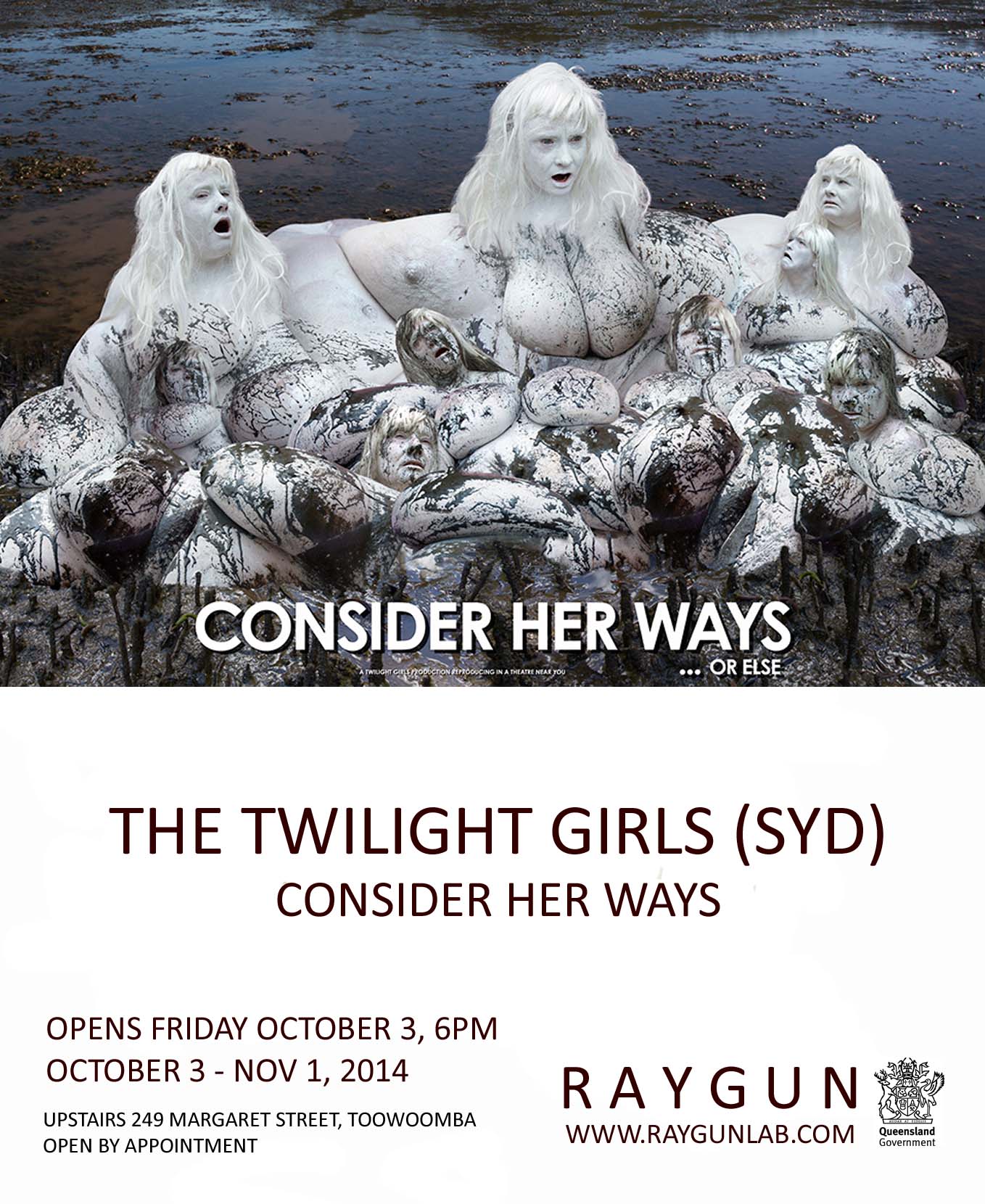
We are looking forward to welcoming The Twilight Girls Helen Hyatt-Johnston and Jane Polkinghorne
at RAYGUN next week! Helen will be joining us for the opening on Friday October 3 at 6pm.
Awesome wild work, we love it.
 RAYGUN