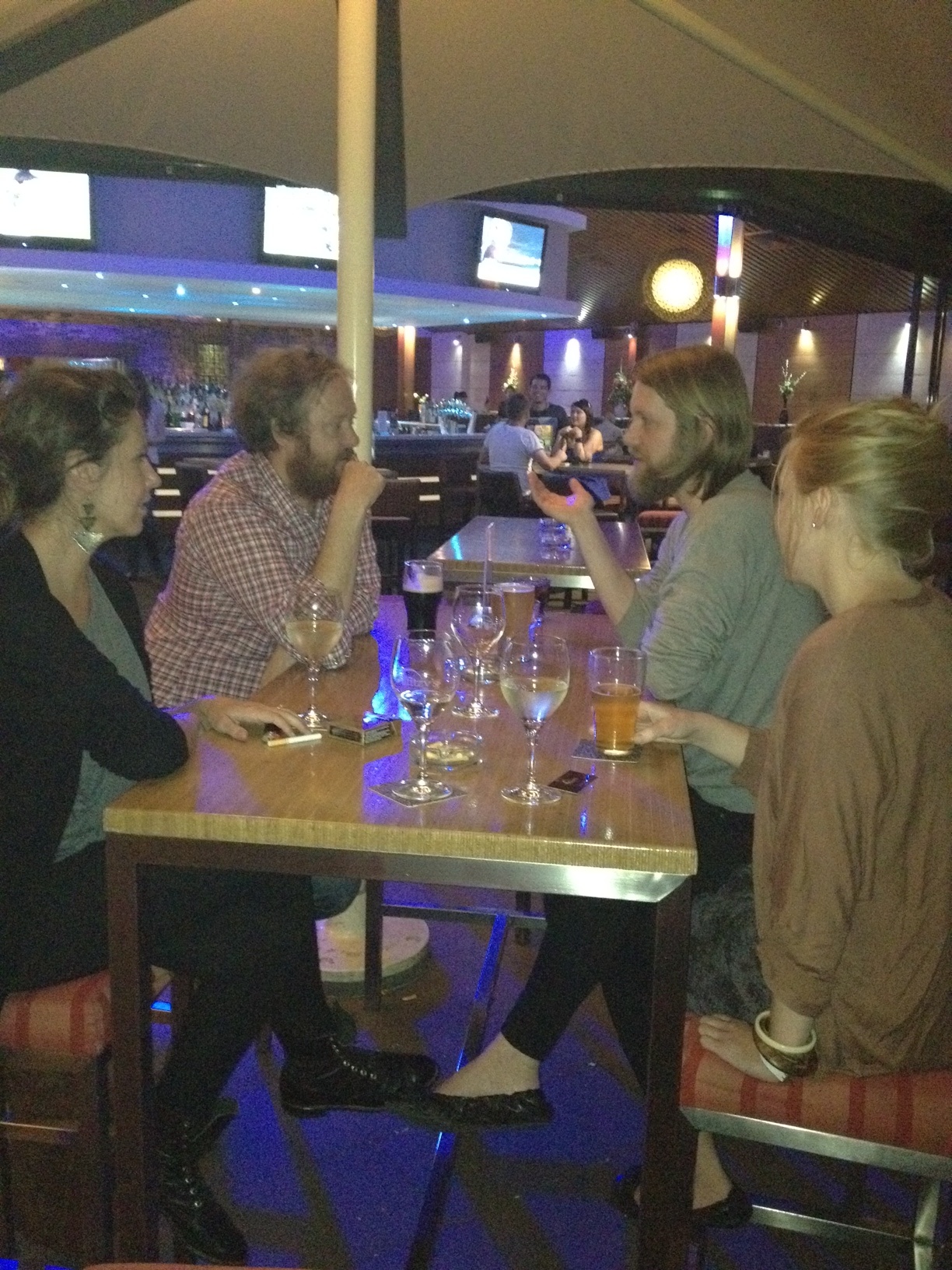
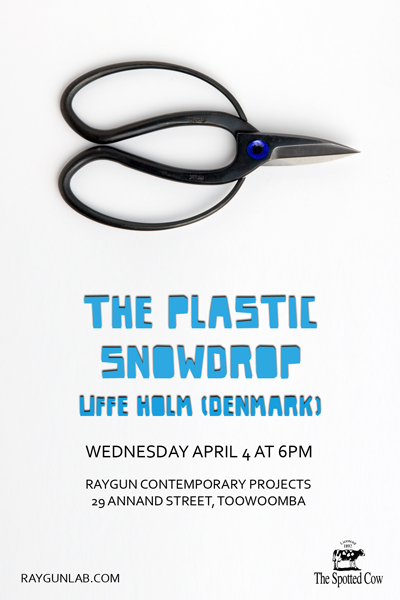
So yesterday was Uffe’s first day in Toowoomba, Australia. Ali and I took him on lots of little trips to hardware stores, art supply shops, garden shops and finally the local watering hole where we offered him an array of our local beers to celebrate his first day. It’s going to be an awesome show and a fun couple of days leading up to the opening night.
UFFE HOLM
Uffe arrives in Australia today with his show at RAYGUN next Wednesday. Ali and I will work with him on his install for the next couple of days so it should be fun. Ali has been racing around town buying topary trees for the night…..
Questions & Answers & Questions
As a practicing artist what are the issues\concerns you have been consistently addressing within your artwork?
As a living being I am consistently addressing a vast number of issues. There is no real dividing line between me as a person and me as a practicing artist. Which makes me an unprofessional artist, or a professional person. And that has mainly been my focus during my practice/life; how we perceive ourselves as human beings and how we try to push these limits.
Do you classify your art as being one thing more than the other e.g. photography, film, painting, sculpture, music or installation and do you see an expansion into other mediums in the future?
My initial response to this question would be something along the lines of: As a conceptual founded artist I choose to follow whatever material the idea would want to materialize itself in – the aesthetics follows the inherent logical conclusions of the becoming of the artwork.That is however not entirely true, or fulfilling as an answer. I very often choose to work with objects in a sculptural sense – because I want them, I fetishize them, and they keep piling up, physically and mentally, and when they get on top of each other they seem to mate, and create new baby thoughts; small soap bubbles of ideas that hover in my studio. The most persistent ones I catch, and they can take on new shapes, as combinations of some of these various objects and take form within another medium. Recently, I’ve used a 3D graphic artist to realize a still image, which in turn might become an animation later on, and in the near future I’ll use a blacksmith to work with copper pipes, for a larger project, but both works are about the body and the it’s representation through a wireframe perspective. The medium is not the message here – I think that if there is a change in sight for me, it might be a change in production, rather than in medium. Which leads me back to my initial sentence, which has now become totally true: As a conceptual founded artist I choose to follow whatever material the idea would want to materialize itself in – the aesthetics follows the inherent logical conclusions of the becoming of the artwork.
When you think about making new work do you always consider applying a degree of historical content or do the works weigh more heavily towards a more personal investigation?
I don’t consider it, it just happens. Everything within sight is of interest, and history is as relevant as the intensity of colour, a geometric abstraction, the newest scientific research or political manifestations. All these things, and more so, are but colours on our canvas, so to speak. I don’t differ between personal investigation and historical content, but I hesitate every time I use my own history as a reference, because there is a fine line between what is true to many people and what is true to me. Some artists understand to walk that fine line, but I guess that’s because their personal history is somewhat synced with what we consider to be the history of the world. Again, I try not to be too deliberate, because then art becomes calculation and that’s manipulation or marketing to me.
When you look back through this body of work do you see any answers unfolding within this investigation?
I have to take this last question very literally. I guess you can see art making as playing with paper fortune tellers. You remember those origami toys, where you fold a piece of paper to a petal, put numbers on the flaps and move them with your fingers until the asker/player is manipulated to choose the flap you want them to choose, under which lies the message that you wrote when you constructed the paper fortune teller. You can only make eight different messages, but as long as your audience changes, you can keep it going for quite some time. I just like looking at all the answers at once. When you have eight truths displayed at the same time, they sort of level each other out, and become the truth about the mechanism, which is in turn perhaps more like a long poem. I like to see my body of work like that. I hope this answers your question?
Sarah Martin – Meeting Expectations
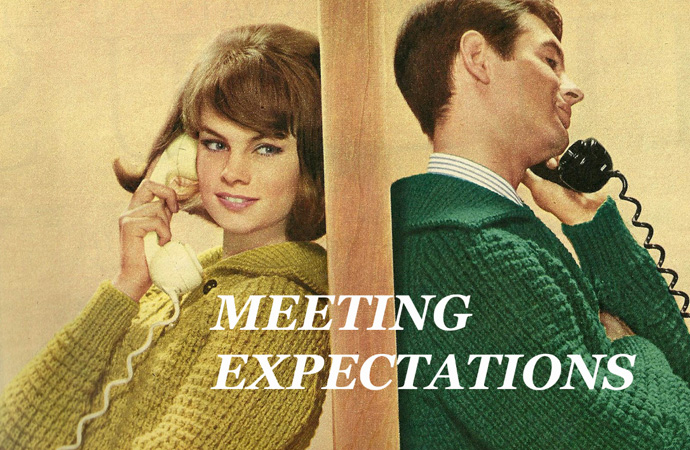
Sarah Martin showed with RAYGUN last September, in the skype conversation we had with Sarah about her exhibition and work she spoke about the project ‘Meeting Expectations’. The project is documented on her website which includes fascinating descriptions by the men Sarah has contacted regarding their perfect partner, with descriptions of a situation or role which Sarah then constructs.
Here’s her description of the project:
Part One
On the eve of my sixteenth post-college break up, I decided to heed the advice of my family and married friends; I should meet a nice Christian man. This advice is most strange to me because I do not consider myself a Christian (and have not for over a decade) and secondly, what would be the difference of dating a Christian vs. non-Christian at this point in my life?
I emailed and messaged the few single Christian men I knew, I joined three Christian dating websites and even went to a Christian Singles mixer in town. I asked the men what they desired in a woman, what expectations did they have and how did I (or could I) fit that expectation?
Seeing myself through their eyes was humbling and frustrating. The truth is that I am undesirable for most because I am getting to old to have multiple children, I have been divorced, I have tattoos, I am too independent and I am not petite.
I find this investigation to be especially enlightening in 2012 as I watch Republican candidates discuss family values, birth control and the church’s role in school and government.
Damien Kamholtz Opening Night
Sharing the love and pics from Damien’s opening night. All the art work left RAYGUN today to go to a second exhibition at the Gold Coast. Thanks Damien, it was fun.
Anarchitecture and Gordon Matta-Clark
I have just found this is a really interesting essay about Gordon Matta-Clark called….
Towards Anarchitecture: Gordon Matta-Clark And Le Corbusier
![]() |
![]() |
Fig.1 Gordon Matta-Clark Bronx Floors: Threshole 1972 2 black and white photographs Each 356 x 508 mm © ARS, NY and DACS, London, 2007 |
‘Architecture is always dream and function, expression of a utopia and instrument of a convenience’, wrote Roland Barthes in The Eiffel Tower and Other Mythologies. In this paper I wish to explore the way in which the language of modernist architecture and the dreams embedded within it impacted on the work of Gordon Matta-Clark (1943–78)….
it’s good and well written.. read on here
My favourite thing ever – work by Adam Moser
Around the dinner table at the McKnights, one of my favourite things in the world.
Paper Monument: Guidelines for Openings

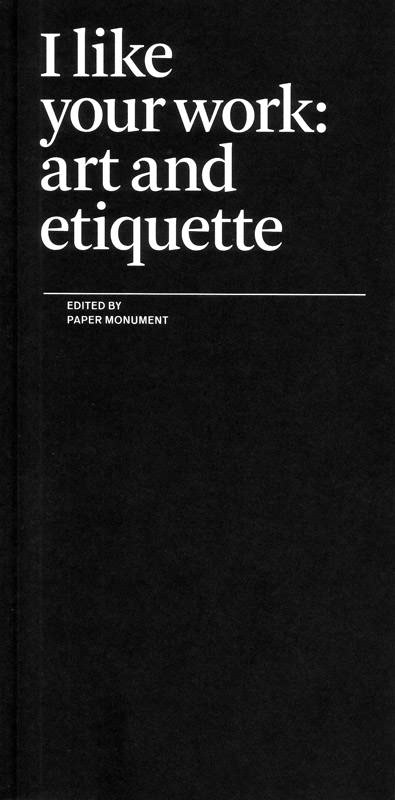
Being a hermit in Greensboro is a great pastime of mine. I use the excuse (to myself and others) 1. I’m making work, the work comes first 2. I need a rest or break 3. It’s okay its just ( insert reason here). When all is said and done seeing the work is what really matters, personally I end up feeling guilty about not going to see a friend, colleague, or students work. As a working artist, (by that I mean I have at least one day job) I think “going to everything” as John Cage put it, is a an important rule all artists should follow. After reading Guidelines for Openings by Andrew Berardini from Paper Monuments book, I like your work: art and etiquette, I believe my part time hermit occupation is over.
-Sam Peck
Damien Kamholtz
This is a taster of how Damien works! He will be showing a different body of work on Saturday night, so this is to get everyone a bit excited. We’ll see you at 6.
1. As a practicing artist what are the issues\concerns you have been consistently addressing within your artwork?
At the moment my work is concerned with exploring stories within stories, I’ve been exploring multi layered narratives, differing perspectives and hidden meaning with in metaphor, symbolic education/communication thru fable, and a visual language that speaks to the emotions rather than the intellect.
I think a major theme that reoccurs in my work is the notion of duality, light/dark, visible/veiled, innocence/experience etc. This occurs both physically and conceptually. At times the work attempts to reconcile opposing elements in a yin yang like fashion, (more often in an entire body of work), other times celebrating contrast and the knowing that the struggle between opposites is inevitably endless and in that, a tragic beauty.
2. Do you classify your art as being one thing more than the other e.g. photography, film, painting, sculpture, music or installation and do you see an expansion into other mediums in the future?
I’ve spent the last few years painting mostly, but I decided early with this body of work that I wanted to create a sense of diversity amongst the works. It includes paintings, drawings, sculpture, 2d assemblages, drawn and photographed animations, sound, projections and film work.
Essentially I’m a painter that does other shit sometimes.
3. When you think about making new work do you always consider applying a degree of historical content or do the works weigh more heavily towards a more personal investigation?
I don’t at any point sit down and think I am going to make either one, of the two though my work is predominantly of a personal nature, but that being said, all of my work, its content and physicality is influenced by all that I come in contact with, whether it’s a dusty book on Butoh in the Library, an anniversary TV special on 9/11 or my daughter losing a tooth.
As an artist one cannot create in a vacuum, (no matter how hard one tries). We are influenced by what has been done, what is being done, we steal, borrow and try and stand on shoulders but It’s the personal filters one applies to historical and popular cultural influence that’s makes ones work more personal.
And though this work references historical characters like Arthur Rimbaud , William Shakespeare, Daedalus and Icarus, and other references ranging from Japanese Butoh dance to the wild west, I don’t consciously consider making works based on popular accounts of history or herstory and in that way I guess It’s more personal.
4. When you look back through this body of work do you see any answers unfolding within this investigation?
In terms of subject matter, the process almost always reveals many more questions than it does answers to questions. I’m still kind of tinkering with this body of work so it’s a little soon. I always need to distance myself from the work physically and for a period of time to then be able to look at them for those answers.
The French writer Henri Michaux wrote that ‘The poet creates , and then understands…sometimes.’
I love that it is not essential to find answers unfolding, but when they do appear they’re often to questions I wouldn’t have thought to ask.
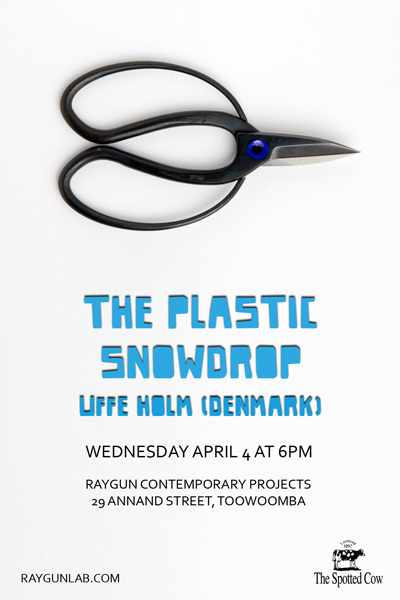
‘THE PLASTIC SNOWDROP’ UFFE HOLM
Uffe Holm is a visual artist based in Copenhagen, Denmark. He graduated from The Royal Danish Academy in Copenhagen in 2007, and has since then exhibited in solo and group shows in Denmark. The Plastic Snowdrop at RAYGUN, Toowoomba, will be his first show abroad. Holm has been a member of the Copenhagen artist-run project space Toves Galleri, situated in the run-down shopping mall by the same name, since its start in 2010, and here he has arranged shows with local and international artists – all with an emphasis on experimenting with the exhibition format.
Artist Statement
Usually I imagine my artistic practice as a soaring flight through a cultural landscape, light as a feather and with an eagle eye for the detail, but in reality I fill up my studio with all kinds of clunky objects, destined for this or that yet unrealised project. I collect these objects as I collect information through my research, in a non-linear way, an associative research gone haywire, where the aesthetics of the projects starts rhyming, multiplying and morphing, leaving a specific meaning behind and making sense as nonsense.
Like a poem.
Which is probably not far from the truth. I started out writing poetry, and was wanting to be a poet, before I found myself in art school, and even though the verses and strophes has disappeared, the approach and the structure is still the same. Every situation is an occasion for a poem, and I think I carried this sensitivity with me, and have become very context-aware, both of the given space, or situation, but also of the internal relations between the works in a show. That’s why each of my shows has their own look. They are collections of poetry-structured works based on found objects and the processes they go through to become works of art.
Uffe Holm, Copenhagen, March 2012
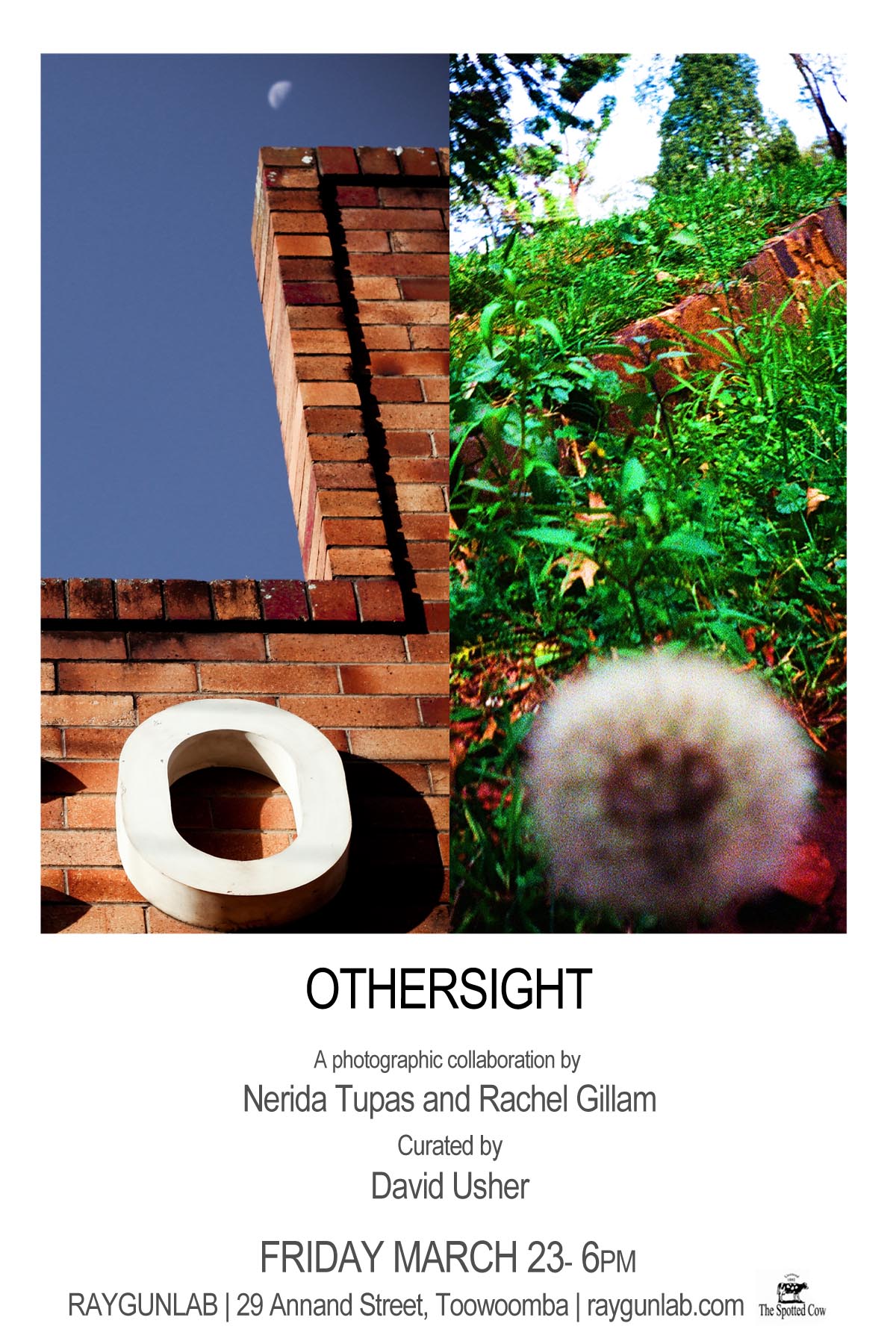
OTHERSIGHT Opens March 23
OTHERSIGHT is curated by David Usher and Features the work of Nerrida Tupas and Rachel Gillam. The work is made by the two artists focussing on the dicotomy between the natural and constructed world.
Interview with Rachel Gillam
1. As a practicing artist what are the issues\concerns you have been consistently addressing within your artwork?
Most recently my work stems from my own feelings and thoughts about the world we live in. I like to reflect upon my surroundings and the effect they have on me. I am constantly assesing my thoughts and feelings; to make artwork which makes me feel happy is very important to me.
2. Do you classify your art as being one thing more than the other e.g. photography, film, painting, sculpture, music or installation and do you see an expansion into other mediums in the future?
I think my creativity comes in all forms, but the work I find most appealing and relevant to my art takes its form in photography.
3. When you think about making new work do you always consider applying a degree of historical content or do the works weigh more heavily towards a more personal investigation?
Personal investigation has always driven my work. It’s something I do even when I’m not making work. I’m constantly questioning myself, my feelings, my thoughts. To make something visual from my unseen thoughts is therapeutic.
4. When you look back through this body of work do you see any answers unfolding within this investigation?
Yes. Because my work is so personal to me I become immersed in the making process. As soon as I see the work laid out in front of me it is as if my thoughts are sitting in front of me, ready to be read and interpreted. As I am constantly questioning myself having a visual interpretation of my thoughts in front of me is just one more method of giving myself answers.